
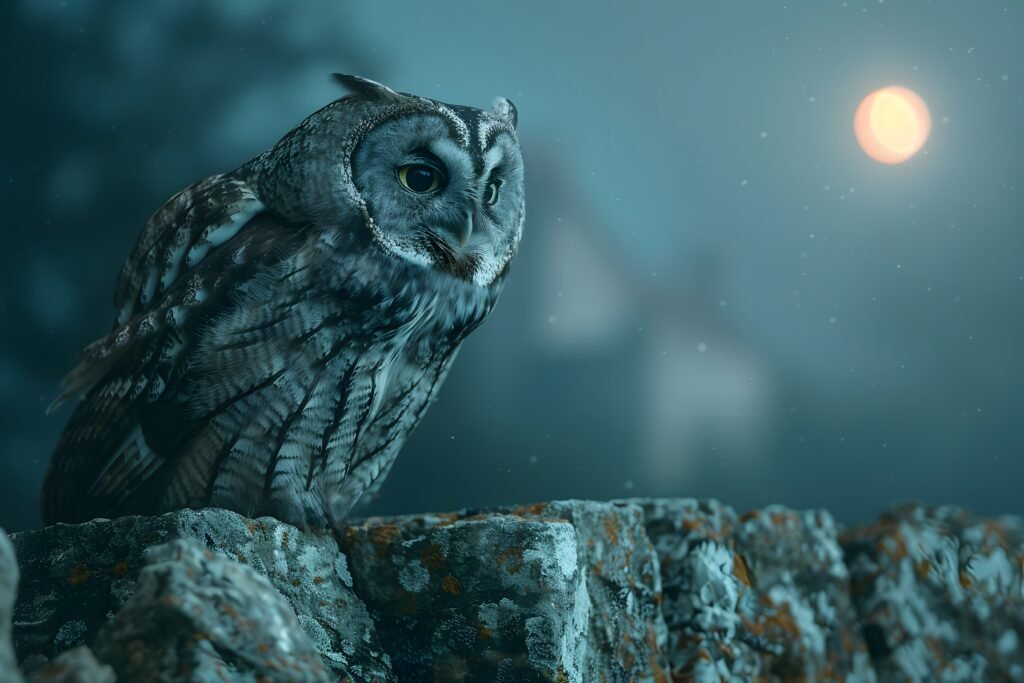
The owl doesn’t move for three hours.
Perched on a branch in the grey hour before dawn. Absolutely still. Not hunting. Just waiting.
Most prey animals are asleep. The world is quiet. And the owl sits.
Eyes open. Every sense alive. Completely present.
But not acting.
What We Got Wrong About Patience
You think patience means waiting for the right moment.
The owl knows patience means BEING the right moment.
Watch an owl hunt. (I have, many nights in Morocco. They’re everywhere once you learn to see them.)
They don’t chase. They don’t prowl. They don’t exhaust themselves searching.
They become absolutely still. And they let the world move around them.
The mouse moves. The owl moves once. It’s over.
Effortless because everything before the strike was perfect stillness.
Why You’re Exhausted
At 3 AM, you’re exhausted because you’ve been moving all day.
Not physically (though maybe that too). Mentally.
Chasing outcomes. Forcing plans. Pushing timelines. Trying to make things happen through sheer will and anxiety.
You think that’s what “taking action” means. That’s what hustle culture sold you. That’s what your anxiety keeps screaming:
Do something. Do anything. Just don’t sit still.
But the owl knows: Most action is just expensive panic.
The Three Stages of the Hunt
Stage 1: The Waiting (This takes the longest)
The owl arrives at the branch. Settles. Becomes still.
Not “trying to be patient.” Not “working on mindfulness.”
Just… still. Alert. Present. Waiting without waiting for anything specific.
This is the part you skip.
You want Stage 3 (the strike, the result, the outcome) without Stage 1 (the long, boring stillness that makes the strike possible).
Stage 2: The Noticing (This takes awareness)
A sound. A movement. A shift in the grass thirty feet away.
The owl doesn’t react. Doesn’t move. Just notices.
Gathers information. Calculates. Confirms.
Still not moving.
This is the part you rush.
You notice the opportunity and immediately lunge. No calculation. No confirmation. Just anxious reaction disguised as “decisive action.”
The owl waits until certainty. You move at the first hint of possibility.
Stage 3: The Strike (This takes everything)
When the owl moves, it moves with complete commitment. Every sense, every muscle, every calculation condensed into one explosive moment.
This is the only part you see. So you think this is the whole teaching.
But the strike only works because of the stillness before it.
What This Means for Your 3 AM Questions
You’re lying there anxious because:
- You don’t know if you should quit the job
- You don’t know if you should send the message
- You don’t know if you should make the move
- You don’t know if you should start the thing
- You don’t know if it’s time to act
And your anxiety is screaming: DO SOMETHING.
The owl would say: Not yet.
How to Practice Owl-Mind
This isn’t meditation. This is predator awareness.
1. Find your branch
Not literally (though literally works too). Find the place where you can be still and watch.
For the owl, it’s a branch with sight lines.
For you, it’s whatever position lets you see clearly without being swept up in the chaos.
Maybe it’s your journal. Maybe it’s a walk. Maybe it’s literally just sitting still for ten minutes without your phone.
2. Stop hunting
You’re not looking for the answer. You’re not searching for the sign. You’re not trying to force clarity.
You’re just being present to what IS.
The owl isn’t hoping for a mouse. The owl is alert to reality, whatever reality brings.
3. Notice without reacting
Thoughts will come. Impulses. Urgencies. Your anxiety will insist THIS IS THE MOMENT TO ACT.
The owl hears every sound in the forest. Doesn’t react to all of them.
Notice what moves in your mind. Don’t strike yet.
4. Wait for certainty
Not perfect information. Not zero risk. But the clear signal that says: Now.
You’ll know it when you feel it. The owl knows when the mouse is exposed. You’ll know when the moment is right.
The difference between you and the owl: The owl trusts the knowing.
5. Strike completely
When you move, MOVE. Not tentatively. Not half-committed. Not “let me test the water.”
All in. Complete commitment. No hesitation.
Then back to stillness.
The Part That Will Annoy You
This means doing nothing most of the time.
The owl sits still for hours to hunt for seconds.
You want to hustle. To make things happen. To be productive. To feel like you’re moving forward.
But most movement is just thrashing.
The owl knows: Strategic stillness beats chaotic motion.
One perfect strike beats a thousand anxious attempts.
What Happens When You Rush
I’ve watched owls miss. It’s rare, but it happens.
Usually because they struck too early. Moved before the mouse was fully exposed. Committed before certainty.
And when they miss? They don’t chase. They don’t spiral. They don’t beat themselves up about the one that got away.
They return to the branch. And wait again.
No drama. No story. Just back to stillness.
You could learn from that too.
For Your 3 AM Anxiety
If you’re awake right now trying to decide whether to act:
You’re not on the branch. You’re thrashing in the grass.
Find your branch. Become still. Let the world move around you.
The right moment will announce itself.
The wrong moment will reveal itself.
But you can’t see either from inside the chaos.
Be the owl. Not the mouse.
The Last Thing
Tomorrow, watch for owls. They’re everywhere at dawn and dusk.
Not moving. Just being. Absolutely present.
Teaching the same lesson they’ve taught for millions of years:
Power isn’t in constant motion. Power is in perfect stillness that knows exactly when to strike.
You’re not lazy for being still.
You’re not passive for waiting.
You’re not wasting time by not forcing it.
You’re being the owl.
And when the moment comes – you’ll know.
In the grey hour, the owl teaches: Be still. Be ready. Strike once.
—Nizar Al Haddad