

mindfulness practice for anxiety
Category: Daily Practices
Series: The Watcher Protocol – Practice 1 of 7
Time Required: 2 minutes
Difficulty: Beginner
Best For: Racing thoughts, anxiety spirals, overwhelm, breaking reactive patterns
What This Practice Does
You’ve learned about The Watcher this week on Instagram—the part of you that observes without judging. But knowing about it isn’t the same as using it.
This is where you actually activate The Watcher.
In just 2 minutes, this practice:
- Interrupts automatic thought loops
- Activates your metacognitive awareness (The Watcher)
- Creates space between stimulus and response
- Shifts you from reactive to responsive mode
- Gives you immediate proof that The Watcher works
This isn’t theory. This is the actual rewiring protocol—distilled to its essence. You can do this anywhere, anytime, and it works immediately.
Think of it as the “emergency reset button” for your nervous system.
The Science: Why 2 Minutes Is Enough
Your brain doesn’t need hours to shift states. Neuroscience shows that 60-90 seconds of focused metacognitive awareness is enough to:
- Decrease amygdala activity (your brain’s panic button)
- Increase prefrontal cortex engagement (executive function)
- Interrupt Default Mode Network rumination (the thought-loop generator)
- Activate the parasympathetic nervous system (rest-and-digest response)
The Sufis knew this 800 years ago. They called it muraqaba—the practice of brief, repeated observation throughout the day. Not long meditation sessions. Quick, deliberate moments of watching.
Modern neuroscience confirms: consistent brief practice beats occasional long sessions.
This 2-minute reset, done 3-5 times daily, literally rewires your brain’s response patterns over time.
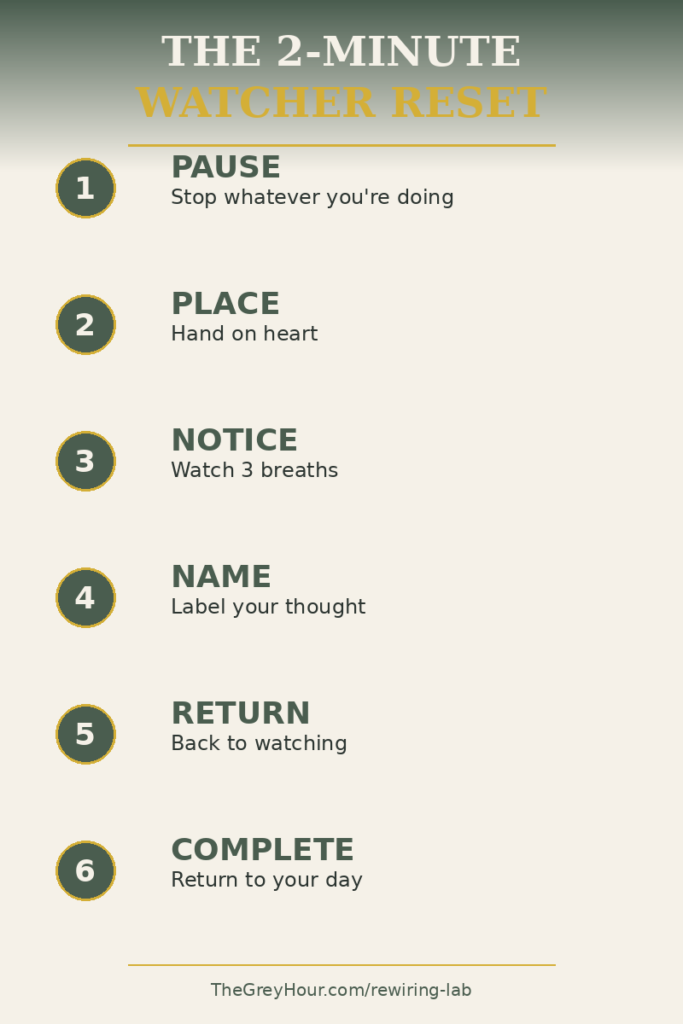
The Practice: Step-by-Step
STEP 1: PAUSE (5 seconds)
Stop whatever you’re doing. If you’re mid-sentence, mid-scroll, mid-thought—doesn’t matter. Pause.
Why this works: The pause itself is the intervention. Most patterns run on autopilot. Stopping interrupts the pattern.
What to notice: The resistance to pausing. The “but I need to finish this first” thought. That’s The Thinker trying to stay in control.
Pro tip: Set 3 daily alarms as “Watcher Reminders” (morning, midday, evening). Practice the pause even when everything feels fine. Train the muscle before you need it.
STEP 2: PLACE (5 seconds)
Put your hand on your heart. Feel the physical contact.
Why this works: Physical anchoring brings you into your body and out of your head. The heart-hand connection activates your vagus nerve, signaling safety to your nervous system.
What to notice: The warmth. The rising and falling with breath. The slowing that happens naturally.
Ancient wisdom: Every contemplative tradition uses physical anchoring—prayer hands, meditation postures, hand positions. It’s not ritual; it’s neuroscience.
STEP 3: NOTICE (30 seconds)
Watch three full breaths. Don’t change them. Don’t deepen them. Don’t “do” breathing.
Just watch.
Inhale… exhale… one.
Inhale… exhale… two.
Inhale… exhale… three.
Why this works: Observation without manipulation is pure metacognition. You’re training The Watcher—the part that can observe your own mental processes without interfering.
What to notice: Your mind will try to wander. Thoughts will arise. That’s not failure—that’s the whole point. Each time you notice you’ve wandered and return to the breath, you’re strengthening The Watcher.
Common mistake: Trying to “clear your mind.” You’re not trying to stop thoughts. You’re practicing watching them without following them.
STEP 4: NAME (10 seconds)
Silently say: “I’m thinking about [whatever you’re thinking about].”
Not as judgment. Just as observation.
Examples:
- “I’m thinking about that email I need to send.”
- “I’m thinking that I’m doing this wrong.”
- “I’m thinking about what’s for dinner.”
- “I’m thinking that this is stupid.”
Why this works: Naming creates distance. When you label a thought, you’re no longer inside it—you’re watching it. This is the gap between stimulus and response.
What to notice: The difference between “I’m anxious” and “I’m thinking anxious thoughts.” One is identification. One is observation.
The shift: You move from “I AM my thoughts” to “I HAVE thoughts.” This is freedom.
STEP 5: RETURN (70 seconds)
Go back to watching your breath. Keep your hand on your heart.
Stay here for the remaining time (about a minute). Watch thoughts arise. Watch them pass. Don’t fight them. Don’t follow them.
Just watch.
Why this works: This is where the rewiring happens. Each moment of non-reactive observation weakens the automatic pathway. Each time you watch without acting, you build The Watcher.
What to notice: Thoughts will keep coming. That’s normal. You’re not trying to achieve “no thoughts.” You’re practicing the relationship of watching rather than being swept away.
The victory: Not in stopping thoughts, but in remaining as The Watcher while they flow.
STEP 6: COMPLETE (final 5 seconds)
Take one more deep breath. Remove your hand. Return to your day.
Crucial insight: The Watcher doesn’t turn off when the practice ends. You’ve activated it. It’s available now.
Throughout your day, you’ll notice moments where you can choose: get swept into reaction (Thinker) or observe from space (Watcher).
This is the transfer from practice to life.
When to Use This Practice
Emergency Use (When you’re activated):
- Anxiety spiral starting
- Anger rising
- Overwhelm hitting
- Racing thoughts won’t stop
- About to react in a way you’ll regret
- Can’t focus, can’t think clearly
How to know you need it: Your body tells you. Tight chest. Shallow breathing. Racing heart. Clenched jaw. That’s The Thinker in control.
The reset: 2 minutes brings The Watcher back online.
Preventive Use (Training the muscle):
- Morning (before checking phone)
- Midday (lunch break or after meetings)
- Evening (transition from work to home)
- Before difficult conversations
- After consuming triggering content
- Any transition point in your day
Why prevention matters: You don’t learn to swim during the hurricane. Train The Watcher in calm moments so it’s available in storms.
Pattern Interruption Use:
Whenever you catch yourself in an automatic pattern:
- Scrolling mindlessly
- Reaching for distraction
- Checking phone compulsively
- Eating when not hungry
- Saying yes when you mean no
- Comparing yourself to others
- Catastrophizing about future
The intervention: Pause. 2-minute reset. Then choose consciously.
What You’ll Notice (Immediate & Long-Term)
Immediately (within 2 minutes):
- Heart rate slows
- Breathing deepens naturally
- Thoughts feel less urgent
- Space appears between you and your reactions
- You feel more “here”
This is The Watcher activating.
After 3 Days (if practiced 3x daily):
- You catch yourself being reactive sooner
- The pause comes more naturally
- You can watch thoughts without believing them (sometimes)
- Patterns feel less automatic
- You notice The Watcher appearing spontaneously
This is neuroplasticity beginning.
After 7 Days (consistent daily practice):
- The Watcher becomes your default in calm moments
- You can access it quickly when triggered
- Thoughts have less power over you
- You respond more, react less
- Space feels normal, not special
This is the new pathway strengthening.
After 21 Days (the rewiring point):
- Observation becomes automatic
- The Watcher is accessible even in high-stress moments
- Old patterns still arise, but you’re no longer controlled by them
- The gap between stimulus and response is your home base
- You live more as witness, less as reactor
This is transformation.
Common Questions & Troubleshooting
Q: “My mind won’t stop. The thoughts keep coming. Am I doing it wrong?”
A: You’re doing it perfectly. The Watcher’s job isn’t to stop thoughts—it’s to watch them. Think of thoughts like cars on a highway. The Thinker is in the car, gripping the wheel. The Watcher is on the bridge above, watching the traffic flow.
Cars keep passing. That’s not failure. That’s the whole point of the practice.
Victory = noticing you were in the car and returning to the bridge.
Q: “I keep forgetting to do this. How do I remember?”
A: Three strategies:
- Anchor to existing habits: Do it right after you brush your teeth, before you eat lunch, when you get into bed.
- Set alarms: Three daily reminders labeled “Watcher Reset” at strategic times.
- Use triggers: Every time you feel resistance, anxiety, or overwhelm—that’s your reminder. The discomfort itself becomes the cue.
Consistency beats perfection. Three messy practices beats one perfect one.
Q: “Is 2 minutes really enough to rewire my brain?”
A: Two minutes isn’t enough to complete rewiring. But it’s enough to begin it.
Think of it like this: One pushup doesn’t give you muscles. But one pushup, repeated daily, builds strength over time.
The 2-minute reset is one neural “rep.” Do it 3x daily for 21 days = 63 reps. That’s enough to create measurable brain change.
Plus: This is Practice 1 of 7 in The Watcher Protocol. Each practice builds on the previous. By Practice 7, you’ll have a complete rewiring system.
Q: “What if I can’t feel The Watcher at all?”
A: You’re already feeling it—you just don’t recognize it yet.
Right now, as you read this, you’re aware that you’re reading. That awareness? That’s The Watcher.
It’s not a special state you have to achieve. It’s the awareness you already have. This practice just trains you to access it deliberately.
Start simple: Can you feel your hand on your heart? Yes? That’s The Watcher noticing the sensation. That’s all you need.
Q: “Can I do this for longer than 2 minutes?”
A: Absolutely. Once you master the 2-minute version, you can extend to 5, 10, or 20 minutes.
But don’t skip the short version. The 2-minute reset is designed for real life—the moments when you don’t have time for a long meditation but desperately need to interrupt a pattern.
Build the skill in short bursts first. Length comes later.
Integration: Making This a Daily Practice
Week 1 Challenge: The 21-Reset Commitment
Goal: Practice this reset 3 times daily for 7 days (21 total resets)
Your three daily times:
- Morning: _____________ (specific time)
- Midday: _____________ (specific trigger or time)
- Evening: _____________ (specific time)
Tracking: Check off each practice. Miss one? No problem. Start again the next day.
Why 21? Research shows 21 repetitions is the minimum needed for your brain to recognize a new pattern. You’re not aiming for perfection—you’re aiming for 21 successful reps.
Integration Questions (Journal after each practice):
Immediately after:
- What was I thinking about when I started?
- Did I resist pausing? Why?
- Could I feel The Watcher observing, even briefly?
End of day:
- Which practice time felt easiest? Hardest?
- Did The Watcher show up spontaneously at any point today?
- What pattern would I most like to bring The Watcher to tomorrow?
End of week:
- How has my relationship with my thoughts changed?
- Can I access The Watcher faster than on Day 1?
- What’s one moment this week where The Watcher made a difference?
These questions train your metacognitive muscle. Thinking about your practice deepens the rewiring.
The Bigger Picture: Why This Practice Matters
You’re not just learning a relaxation technique.
You’re training the foundational skill for all pattern-breaking work.
Every pattern that keeps you stuck—people-pleasing, perfectionism, comparison, avoidance, overthinking, self-criticism—runs on autopilot in The Thinker.
The Watcher is the only way out.
You can’t think your way out of automatic thinking. You can’t willpower your way out of unconscious patterns. You can only watch your way to freedom.
This 2-minute reset is your training ground.
Master this, and you have the tool to work with any pattern. Skip this, and every other protocol will be harder than it needs to be.
The Watcher is the foundation. Everything else builds from here.
What’s Next: The Complete Watcher Protocol
This is Practice 1 of 7 in The Watcher Protocol series.
Coming in The Watcher’s Way (7-day guide):
- Practice 2: The Thought Labeling Protocol (for anxiety & rumination)
- Practice 3: The Emotion Observer (for overwhelming feelings)
- Practice 4: The Gap Training (for reactive moments)
- Practice 5: The Pattern Tracker (for identifying your specific patterns)
- Practice 6: The Daily Watcher Audit (for integration)
- Practice 7: The Watcher’s Way of Life (full embodiment)
Each practice takes 2-10 minutes. Each builds your Watcher muscle. Each targets a specific rewiring need.
Together, they form a complete system for breaking the patterns keeping you stuck.
The 2-Minute Reset is your entry point. Master it this week. The rest follows.
Your Practice Starts Now
You could read about The Watcher for months.
Or you could practice it for 2 minutes and actually feel the shift.
Right now. Before you scroll. Before you close this tab.
- Pause
- Hand on heart
- Three breaths
- Name your thought
- Return to watching
Two minutes. That’s all.
The Watcher is waiting. The rewiring begins the moment you practice.
This is Practice 1 from The Rewiring Lab—where ancient wisdom meets modern neuroscience in systematic protocols for breaking patterns. New practices posted weekly. Follow along at thegreyhour.com/rewiring-lab.
For the complete 7-day Watcher Protocol and systematic rewiring for 12 core patterns, see The Watcher’s Way (coming soon).
Follow @owl.daze on Instagram for daily Watcher wisdom.
References & Further Reading
Ancient Wisdom Sources:
- Sufi practice of muraqaba (self-observation)
- Buddhist vipassana meditation (insight through observation)
- Stoic prosoche (attention to present moment)
Modern Neuroscience:
- Brewer, J. et al. (2011). “Meditation experience is associated with differences in default mode network activity.” PNAS.
- Tang, Y. et al. (2015). “The neuroscience of mindfulness meditation.” Nature Reviews Neuroscience.https://www.nature.com/articles/nrn3916
- Hölzel, B.K. et al. (2011). “Mindfulness practice leads to increases in regional brain gray matter density.”
Practical Application:
- Hayes, S.C. et al. (2011). Acceptance and Commitment Therapy (metacognitive defusion techniques)
- Kabat-Zinn, J. (1990). Full Catastrophe Living (brief mindfulness practices)
What pattern are you bringing The Watcher to this week? Share in the comments below.
Mindfulness Practice for anxiety- End of Practice
Stay tuned for Practice #2

Hi Nizar, I just wanted to tell you how much I love the Re-Wiring Lab why I’m doing it with you!! The way you explain The Watcher makes something I’ve felt intuitively for a long time suddenly feel usable in real life. I love how grounded and step-by-step you made the practice, nothing abstract, nothing intimidating, just very human and totally doable. Whether someone is completely new to this or has years of experience, it meets you exactly where we are. It feels like an invitation rather than an instruction, which makes all the difference, in my humble opinion. I really relate to the focus on short, repeatable pauses, as I am already doing those myself, especially the idea of interrupting patterns in the moment instead of trying to fix everything later in reflection. It does not work that way and this is what many so called big authors miss. I also love how non-performative you make it, it doesn’t ask us to be calm or good at it, just willing to pause and to notice. Wow! Thank you for making this so practical, humane, and accessible, and for translating something deep into something we can actually do, with intention and small daily steps. That kind of clarity is rare, Nizar, you are a true modern-day philosopher, please be proud of this work, what an honor. Congratulations!
Thank you so much Sofia for these thoughtful words—they mean more than you know. What touches me most is your recognition that The Re-Wiring Lab feels like an invitation rather than instruction, that it meets people exactly where they are without performance or intimidation. You’ve identified something I worked hard to preserve: that the practice doesn’t ask you to be calm or good at it, just willing to pause and notice.
Your insight about interrupting patterns in the moment rather than trying to fix everything later in reflection—this is exactly right, and you’re correct that many approaches miss this. Real change happens in the micro-moments, in those short, repeatable pauses you’re already practicing, not just in retrospective analysis.
The fact that you’re doing this work alongside me, bringing your own experience and wisdom to it, makes the Lab what it is. You’re not just following a protocol—you’re living the inquiry, which is what The Watcher practice truly asks of us.
Thank you for your generosity, for seeing the intention behind the work, and for walking this path with such honesty. Your support and engagement honor me deeply. Congratulations to you as well—for showing up, for practicing, for choosing awareness again and again.
Grateful for you Sofia & really appreciated
-Nizar