

From Loneliness (Pain) to Solitude (Glory)
30 Day Solitude Practice
Category: Transformation Protocols
Series: The Watcher Applied – Practice 2 of 7
Time Required: 20 minutes daily + micro-practices
Difficulty: Intermediate
Best For: Chronic loneliness, social exhaustion, self-abandonment, fear of being alone, people-pleasing patterns
“Language has created the word ‘loneliness’ to express the pain of being alone. And it has created the word ‘solitude’ to express the glory of being alone.”
— Paul Tillich
Same aloneness. Two completely different experiences.
The difference? The Watcher.
Download your Free PDF now
The Truth About Modern Loneliness
You’re surrounded but feel completely alone.
Connected to hundreds online but deeply, devastatingly lonely.
And you’ve been carrying a secret shame about it: “Something’s wrong with me. I should have more friends. I should be better at this.”
Let me tell you something that might change everything:
You’re not broken. You’re human in an epidemic.
60% of adults report feeling lonely regularly. Young adults (18-34) are the loneliest generation in recorded history. This isn’t rare. This isn’t you failing. This is epidemic-level suffering.
We’re more “connected” than ever—and more lonely than ever. The paradox is the crisis.
Why You Feel Lonely Even When Surrounded
Here’s what most people don’t understand about loneliness:
It’s not about being physically alone.
You can be:
- Married and lonely
- Have 500 friends online and lonely
- At a party surrounded by people and lonely
- In constant conversation and lonely
Because loneliness isn’t about the absence of people.
It’s about the absence of genuine connection—to others, yes, but especially to yourself.
You’ve been so busy performing for others—being who they need, saying what works, hiding what doesn’t—that you’ve abandoned the one person who’s always there.
You.
And that abandonment? That’s what creates the deepest kind of loneliness.
The ache you feel isn’t just about needing more friends.
It’s about missing yourself.
The Neuroscience: Why Loneliness Hurts Like Physical Pain
This isn’t metaphor. This is measurable brain science.
When researchers put lonely people in brain scanners, they discovered something profound:
Loneliness activates the same brain regions as physical pain.
Specifically:
- The anterior cingulate cortex (the brain’s pain processor) lights up
- The insula (which processes both physical and emotional suffering) activates
- Your brain releases the same distress signals as when you’re physically injured
Your grandparents weren’t being dramatic when they talked about heartache. Social pain is processed as real pain by your brain.
This is why loneliness:
- Hurts in your chest
- Makes you physically ache
- Feels like actual wounding
- Causes real suffering
Your pain is valid. It’s biological. It’s not weakness. It’s how humans are wired.
We’re social mammals. Connection isn’t a luxury—it’s a survival need. When that need isn’t met, your brain signals danger.
But here’s what changes everything:
The way out of loneliness isn’t always more connection to others. Sometimes it’s deeper connection to yourself.
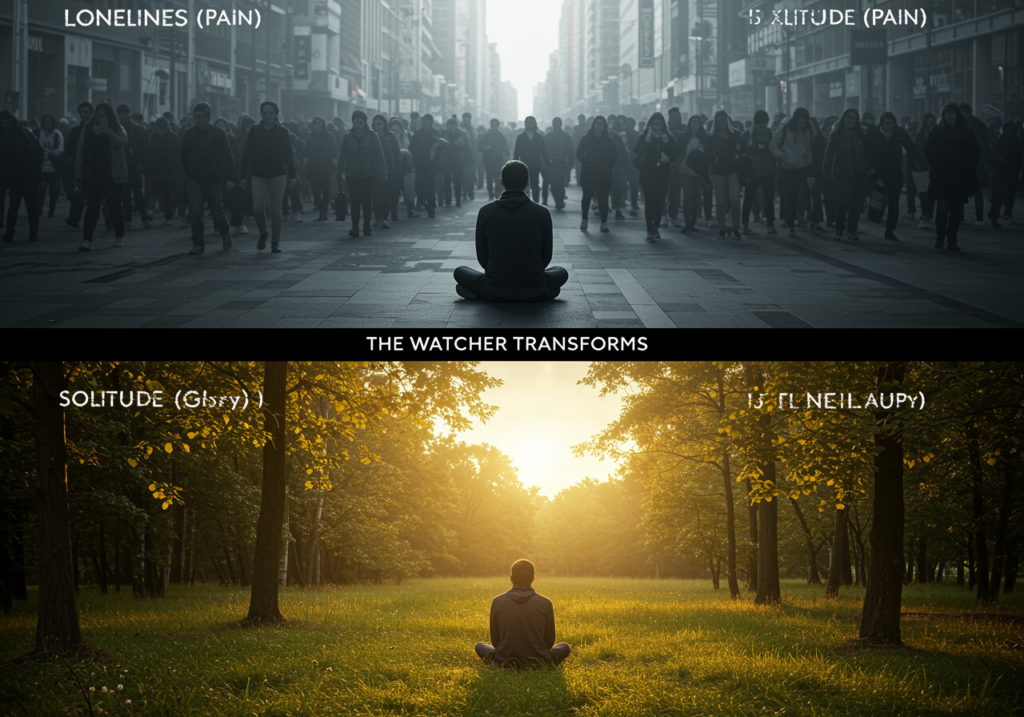
Loneliness vs. Solitude: The Critical Distinction
Most people think these are the same thing. They’re not.
Loneliness (The Suffering):
- Feels like: Exile, abandonment, deficiency
- Message: “Something’s wrong. I’m not enough. I need rescue.”
- Energy: Desperate, grasping, painful
- Focus: What’s missing (people, connection, belonging)
- Pattern: Running from yourself into distraction
- Result: More pain, deeper isolation
Solitude (The Sacred):
- Feels like: Homecoming, fullness, presence
- Message: “I’m whole. I’m enough. I’m here.”
- Energy: Peaceful, spacious, nourishing
- Focus: What’s present (yourself, awareness, being)
- Pattern: Returning to yourself with The Watcher
- Result: Self-companionship, inner peace, genuine connection
Same aloneness. Completely different relationship to it.
The ancient mystics knew this. The Desert Fathers didn’t flee to the wilderness because they hated people. They went to discover something in solitude that crowds obscured:
The presence of their own awareness. The companionship of The Watcher. The glory of being whole with yourself.

How The Watcher Transforms Loneliness Into Solitude
Here’s the mechanism:
Loneliness happens when you’re alone and identified with The Thinker.
The Thinker says:
- “I’m so alone.”
- “Nobody understands me.”
- “I’ll always be this way.”
- “Something’s wrong with me.”
- “I can’t stand being with myself.”
You believe these thoughts. You become them. The loneliness intensifies.
Solitude happens when you’re alone and resting as The Watcher.
The Watcher observes:
- “There’s a thought: ‘I’m so alone.'”
- “There’s a feeling: loneliness in the chest.”
- “There’s a story: ‘I’ll always be this way.'”
- “There’s resistance to being alone.”
You watch these arising. You don’t become them. The relationship shifts.
The presence that’s watching—that’s your companion. That’s who’s always been here. That’s The Watcher.
And when you learn to rest as The Watcher, aloneness stops being exile and starts being return.
Not because the loneliness disappears. But because you’re no longer alone with it.
The Watcher is always here. You can’t be abandoned by your own awareness.
What The Ancient Mystics Discovered
Every contemplative tradition—across cultures, across centuries—arrived at the same insight:
True solitude isn’t isolation. It’s the deepest form of connection.
The Desert Fathers (Christian Contemplatives):
“Go, sit in your cell, and your cell will teach you everything.”
— Abba Moses
They discovered that external silence revealed internal noise—and that The Watcher could transform that noise into peace.
The Sufi Mystics (Islamic Contemplatives):
“The one who knows himself knows his Lord.”
— Prophet Muhammad (Hadith)
They practiced khalwa (spiritual retreat) not to escape the world, but to discover the divine presence within their own awareness.
The Buddhist Monks:
“Better than a thousand hollow words is one word that brings peace.”
— Buddha
They sat in silence for years—not avoiding life, but discovering that the peace they sought was already present in The Watcher.
The Stoic Philosophers:
“Nowhere can man find a quieter or more untroubled retreat than in his own soul.”
— Marcus Aurelius
They taught that external circumstances don’t create peace. The retreat is internal. The sanctuary is your own awareness.
They weren’t teaching loneliness. They were teaching solitude. The glory of being alone—with The Watcher.
The 30-Day Protocol: How Transformation Actually Happens
This isn’t a meditation course. This isn’t self-help advice.
This is a systematic protocol for rewiring your relationship with aloneness.
30 days. 20 minutes daily. Micro-practices throughout the day.
At the end, loneliness won’t disappear. But it will transform. From enemy to teacher. From suffering to sacred.
The Structure:
Days 1-7: Foundation (Meeting The Watcher in Solitude)
Days 8-14: Deepening (Sitting With Loneliness Without Running)
Days 15-21: Integration (Befriending Yourself)
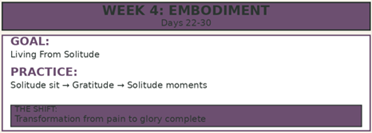
Days 22-30: Embodiment (Living From Solitude)
Each week builds. Each practice compounds. By Day 30, you won’t be the same person who started.
WEEK 1 (Days 1-7): Foundation – Meeting The Watcher in Solitude
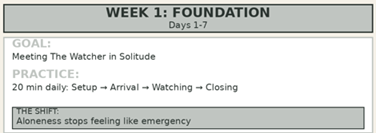
The Goal:
Learn to be alone with yourself without immediately reaching for distraction.
Daily Practice (20 minutes):
Step 1: The Setup (2 minutes)
Find a quiet space. No phone. No music. No distractions.
Sit comfortably. Eyes open or closed—doesn’t matter.
Set a gentle timer for 20 minutes.
Why this works: You’re creating a container for aloneness. No escape routes. No rescue coming. Just you.
What to notice: The immediate urge to check something, do something, fix something. That’s The Thinker afraid of aloneness.
Step 2: The Arrival (3 minutes)
Place your hand on your heart.
Notice three breaths.
Say silently: “I’m here. I’m alone. The Watcher is present.”
Why this works: You’re acknowledging reality without resistance. Aloneness isn’t the problem. Fighting aloneness is.
What to notice: The difference between “I’m lonely” (identification) and “I’m alone” (observation).
Step 3: The Watching (12 minutes)
Simply sit. Watch whatever arises.
Thoughts will come:
- “This is stupid.”
- “I should be doing something.”
- “I’m so lonely.”
- “When will this be over?”
Watch them. Name them. Let them pass.
Feelings will come:
- Restlessness
- Anxiety
- Sadness
- Loneliness
Feel them. Locate them in your body. Breathe with them.
Don’t try to fix anything. Don’t try to feel different. Just watch.
Why this works: You’re training The Watcher to stay present with aloneness without collapsing into loneliness.
What to notice: The moments—even brief—where aloneness feels peaceful instead of painful.
Step 4: The Closing (3 minutes)
Place your hand on your heart again.
Say silently:
- “I practiced being with myself.”
- “The Watcher was here the whole time.”
- “I’m learning to befriend aloneness.”
Take three deep breaths.
Why this works: You’re acknowledging the practice completed. Not the outcome achieved. Practice, not perfection.
Micro-Practice Throughout Day (Week 1):
The Alone-Check
Three times daily, notice: “Am I alone right now?”
If yes:
- Notice the immediate urge to reach for your phone
- Pause for 10 seconds
- Say: “The Watcher is here”
- Continue with what you were doing
Why this works: You’re catching the automatic pattern of fleeing aloneness before it fully activates.
Week 1 Integration Questions (Journal nightly):
- Resistance: What was my biggest urge to escape during the 20 minutes?
- Discovery: Was there any moment—even 5 seconds—where aloneness felt okay?
- Pattern: When did I reach for distraction today? What was I avoiding?
- Watcher: Could I feel The Watcher observing, even briefly?
WEEK 2 (Days 8-14): Deepening – Sitting With Loneliness Without Running
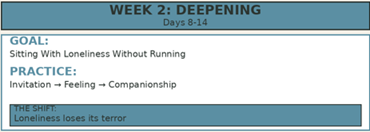
The Shift:
Week 1 was about being alone. Week 2 is about being with loneliness when it arises—without running.
Daily Practice (20 minutes):
Step 1: The Invitation (5 minutes)
Sit quietly. Hand on heart.
Instead of avoiding loneliness, invite it:
“Loneliness, if you’re here, I’m willing to feel you. The Watcher will stay present.”
Why this works: You’re reversing the pattern. Instead of running, you’re turning toward. This is radical.
What to notice: Loneliness often softens when you stop resisting it.
Step 2: The Feeling (10 minutes)
If loneliness arises:
Locate it physically:
- Where in your body? (Chest? Throat? Stomach?)
- What’s the sensation? (Tight? Heavy? Empty? Aching?)
- What’s the temperature? (Cold? Hot?)
Name the thoughts:
- What’s The Thinker saying?
- “I’m so lonely.”
- “I’ll always be alone.”
- “Nobody cares about me.”
Watch without believing:
- “There’s the loneliness thought.”
- “There’s the forever story.”
- “There’s the unloved narrative.”
Let The Watcher hold it all.
Why this works: Loneliness loses power when observed rather than resisted. The Watcher creates space.
What to notice: Loneliness comes in waves. It’s not constant. It rises and falls. The Watcher remains.
Step 3: The Companionship (5 minutes)
Say to yourself:
“I’m lonely right now. And The Watcher is here with me. I’m not alone in my loneliness.”
Feel the truth of that. You’re watching your loneliness. The Watcher is your companion.
Why this works: You’re distinguishing between the feeling (loneliness) and the presence (The Watcher). One changes. One remains.
Micro-Practice Throughout Day (Week 2):
The Loneliness Pause
When loneliness hits during the day:
- Pause whatever you’re doing
- Place hand on heart
- Say: “Loneliness is here. The Watcher sees it.”
- Three breaths
- Continue
Don’t try to fix the loneliness. Just acknowledge The Watcher’s presence with it.
Why this works: You’re breaking the automatic pattern: feel lonely → run to distraction. New pattern: feel lonely → The Watcher stays → feeling shifts naturally.
Week 2 Integration Questions:
- Face: Did I let myself actually feel loneliness this week, or did I still avoid it?
- Companion: Could I sense The Watcher as present with the loneliness?
- Wave: Did I notice loneliness coming and going, rather than being constant?
- Shift: What changed when I stopped running from it?
WEEK 3 (Days 15-21): Integration – Befriending Yourself
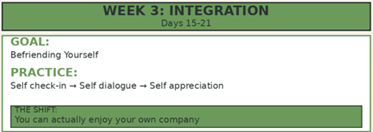
The Transformation:
Week 3 is where you actively practice self-companionship. Not as narcissism. As ending self-abandonment.
Daily Practice (20 minutes):
Step 1: The Self-Check-In (5 minutes)
Sit quietly. Ask yourself (like you’d ask a friend):
- “How are you today?”
- “What do you need right now?”
- “What’s been hard lately?”
- “What’s been good?”
Listen. Actually listen. Let answers arise.
Why this works: Most people never ask themselves these questions. They’re too busy performing for others. This is returning home.
Step 2: The Self-Dialogue (10 minutes)
Have an actual conversation with yourself. Out loud if you’re comfortable, silently if not.
Talk to yourself like a friend:
“I know you’ve been feeling lonely.”
“I know it’s been hard.”
“I see you. I’m here.”
Respond as yourself:
“Thank you.”
“I needed to hear that.”
“I’m scared of being alone forever.”
Continue the dialogue. The Watcher holds both sides.
Why this works: You’re ending the abandonment. You’re becoming your own companion. This is the shift from loneliness to solitude.
What to notice: How strange this feels at first. How natural it becomes.
Step 3: The Self-Appreciation (5 minutes)
Say three things you appreciate about yourself today:
“I appreciate that I’m doing this practice even though it’s hard.”
“I appreciate my honesty about my loneliness.”
“I appreciate that I’m learning to befriend myself.”
Why this works: You’re cultivating genuine regard for yourself. Not as ego. As companionship.
Micro-Practice Throughout Day (Week 3):
The Self-Companion Check
Five times daily, ask yourself:
“How am I doing right now?”
Listen for 10 seconds. Adjust if needed:
- Take a break if tired
- Eat if hungry
- Rest if overwhelmed
- Move if restless
Treat yourself like someone you’re responsible for caring for. Because you are.
Why this works: You’re training yourself to pay attention to yourself—the foundation of self-companionship.
Week 3 Integration Questions:
- Listening: Did I actually listen when I asked myself how I was?
- Care: Did I treat myself like I’d treat a friend I care about?
- Presence: Could I feel my own presence as companionship?
- Shift: Is aloneness starting to feel different than it did two weeks ago?
WEEK 4 (Days 22-30): Embodiment – Living From Solitude
The Integration:
Week 4 is where solitude becomes your home base, not a practice you do.
Daily Practice (20 minutes):
Step 1: The Solitude Sit (15 minutes)
Sit in silence. No agenda. No technique. Just being.
With yourself.
As The Watcher.
In solitude.
Let it be sacred. Let it be boring. Let it be whatever it is.
This is you, whole, present, alone—and complete.
Why this works: You’re not doing solitude. You’re being it.
Step 2: The Gratitude (5 minutes)
Thank yourself for these 30 days.
Thank The Watcher for being present.
Thank solitude for teaching you.
Why this works: Gratitude completes the transformation. You’ve moved from enemy to friend.
Micro-Practice Throughout Day (Week 4):
The Solitude Moments
Deliberately choose moments of solitude:
- Morning coffee alone (no phone)
- Lunch without distraction
- Evening walk in silence
- Five minutes before bed
Not as punishment. As return. As home.
Why this works: You’re choosing solitude, not enduring it. That’s the shift.
Week 4 Integration Questions:
- Home: Does solitude feel like home, or still like exile?
- Choice: Am I choosing aloneness sometimes, or still avoiding it?
- Presence: Is The Watcher my companion now, or still a concept?
Glory: Have I experienced even a moment of what Tillich called “the glory of being alone”?
What Changes After 30 Days (Real Expectations)
Let me be honest about what this protocol does and doesn’t do:
What WON’T Change:
- ❌ Loneliness won’t disappear completely
- ❌ You won’t suddenly love being alone all the time
- ❌ You won’t stop wanting connection with others
- ❌ Being alone won’t always feel peaceful
What WILL Change:
- ✅ Loneliness loses its terror
- ✅ Aloneness stops feeling like exile
- ✅ You have a companion (The Watcher) who never leaves
- ✅ Solitude becomes available as refuge, not just punishment
- ✅ You can be with yourself without constant distraction
- ✅ Self-abandonment patterns become visible
- ✅ People-pleasing softens (because you’re no longer desperate)
- ✅ The panic of aloneness transforms into peace (sometimes)
The transformation isn’t from lonely to never lonely.
It’s from lonely (pain) to solitude (glory)—from suffering to sacred.
Troubleshooting: When The Practice Gets Hard
“I can’t sit still for 20 minutes. My mind won’t stop.”
You’re not trying to stop your mind. You’re trying to watch it.
The Thinker will think. That’s its job.
The Watcher will watch. That’s its nature.
Start with 5 minutes if 20 is too much. Progress, not perfection.
“I just feel more lonely when I practice.”
That’s actually progress, not failure.
You’re finally feeling the loneliness you’ve been avoiding. The Watcher is present enough to hold it.
Keep going. The turning point comes after you stop running.
“I don’t have 20 minutes a day.”
Yes, you do. You have 2+ hours on your phone daily (average).
You don’t have a time problem. You have a priority problem.
This practice will change your life. Scrolling won’t.
“Nothing’s happening. I don’t feel different.”
Transformation isn’t always dramatic. Sometimes it’s subtle:
- Reaching for phone slightly less
- Sitting alone for 30 seconds without panic
- One moment of peace in aloneness
These are the micro-shifts that compound into rewiring.
Trust the process. Keep practicing.
“I did one week and stopped. Can I start again?”
Yes. Right now.
You don’t have to start over from Day 1. Pick up where you left off. Or start fresh if that feels better.
The practice works when you practice it. That’s the only requirement.
The Deeper Truth: Why This Protocol Actually Works
This isn’t positive thinking. This isn’t self-help fluff.
This is neuroplasticity applied to your relationship with aloneness.
Every time you:
- Sit with loneliness instead of running (Step 2, Week 2)
- Befriend yourself instead of abandoning yourself (Week 3)
- Choose solitude instead of avoiding it (Week 4)
You’re rewiring the neural pathway from aloneness = danger to aloneness = home.
The Thinker’s automatic pattern: Alone → Danger → Run → Distraction → Relief (temporary)
The Watcher’s new pattern: Alone → Notice → Stay → Observe → Peace (deepening)
30 days. 20 minutes daily. That’s 10 hours of rewiring.
Research shows neuroplastic change happens around 21-30 days of consistent practice.
You’re not just changing how you think about aloneness. You’re changing your brain’s response to it.
This is how transformation happens. Not through understanding, but through practice.
Beyond The Protocol: Living From Solitude
After 30 days, the practice doesn’t end. It evolves.
Solitude becomes a sanctuary you can always return to:
- When overwhelmed by people
- When exhausted from performing
- When you need to reconnect with yourself
- When life gets too loud
You’ll still want connection. You’ll still value relationships.
But you won’t be desperate for them. You won’t abandon yourself to maintain them.
Because now you know:
You can be alone without being lonely. You can be whole with yourself. The Watcher is always here.
That’s the glory Paul Tillich was talking about.
That’s what the ancient mystics discovered.
That’s what this protocol teaches.
Your 30 Days Start Now
You’ve read about the loneliness epidemic.
You’ve learned the distinction between loneliness and solitude.
You’ve seen the neuroscience of social pain.
You’ve been taught how The Watcher transforms the relationship.
Now: will you practice?
30 days. 20 minutes daily. Micro-practices throughout.
At the end:
You won’t be fixed. You won’t be perfect.
But you will have a different relationship with aloneness.
From enemy to teacher. From suffering to sacred. From lonely to solitude.
The Watcher is waiting. The protocol is here. Your transformation begins the moment you start.
Download Your 30-Day Practice Tracke
What You’ll Get:
- Daily practice instructions (all 4 weeks)
- Micro-practice reminders
- Weekly integration questions
- Progress tracking checkboxes
- Solitude journal prompts
- Emergency protocol for intense loneliness
Related Practices from The Rewiring Lab:
- Practice 1: The 2-Minute Watcher Reset (for when loneliness hits suddenly)
- Practice 3: The Emotion Observer (for sitting with difficult feelings) – Coming Soon
- Practice 4: The Pattern Tracker (for identifying self-abandonment patterns) – Coming soon
This is Practice 2 from The Rewiring Lab—where ancient wisdom meets modern neuroscience in systematic protocols for breaking patterns.
For the complete Watcher Protocol addressing all 12 core patterns, see The Watcher’s Way (7-day systematic guide).
Follow @owl.daze on Instagram for daily wisdom on transforming loneliness into solitude.
Scientific References & Further Reading
Neuroscience of Social Pain:
- Eisenberger, N.I. et al. (2003). “Does rejection hurt? An fMRI study of social exclusion.” Science.
- Cacioppo, J.T. & Patrick, W. (2008). Loneliness: Human Nature and the Need for Social Connection.
Loneliness Epidemic Research:
- Murthy, V. (2020). Together: The Healing Power of Human Connection in a Sometimes Lonely World.
- Cigna 2021 Loneliness Index (showing 61% of Americans report feeling lonely)
Contemplative Practices & Solitude:
- Storr, A. (1988). Solitude: A Return to the Self.
- Merton, T. (1960). The Wisdom of the Desert (Desert Fathers teachings)
Neuroplasticity & Practice:
- Brewer, J. et al. (2011). “Meditation experience is associated with differences in default mode network activity.” PNAS.
- Hölzel, B.K. et al. (2011). “Mindfulness practice leads to increases in regional brain gray matter density.”
Ancient Wisdom Sources:
- Tillich, P. (1963). The Eternal Now (loneliness vs. solitude distinction)
- Aurelius, M. Meditations (Stoic practice of internal retreat)
- Islamic Sufi texts on khalwa (spiritual solitude practice)
What’s your relationship with aloneness right now? Loneliness or solitude? Share in the comments—you’re not alone in this.

Oh, I loved this one so much, Nizar, and I think I know exactly why. What I appreciate most about your blog is that you don’t shame loneliness, you normalize it. “You’re not broken. You’re human in an epidemic.” That feels like a remedy already. So many of us carry quiet embarrassment about feeling lonely, even when we’re surrounded by people. The way you name it as collective, biological, wired into our nervous systems, it takes away that self-blame, and this is huge. And then the distinction you make, loneliness vs. solitude. “Same aloneness. Two completely different experiences.” That stayed with me, because I’ve lived both. I know the version of being alone that feels like exile, the chest ache, the reaching for distraction, the subtle panic. But I’ve also tasted the other side when being alone feels spacious and sacred. I love that you don’t promise that loneliness will disappear with the practice, it promises that our relationship to it can change with the help of The Watcher. This is outstanding, Nizar, congratulations. Thank you!
Thank you Sofia, for your elaborate and thoughtful comment. You’re absolutely right that the work isn’t about making loneliness disappear but about changing our relationship to it through The Watcher’s gentle observation. The shift from “I’m broken for feeling this” to “I’m human in an epidemic” removes the shame that compounds the original pain. When we understand loneliness as collective, biological, wired into our nervous systems rather than personal failure, we can meet it with curiosity instead of self-blame.
What moves me is that you’ve discovered firsthand what the practice teaches: same aloneness, two completely different experiences depending on whether we’re fleeing ourselves or staying present. This is the transformation The Watcher makes possible—not immunity to loneliness but the capacity to sit with it without abandoning ourselves.
Thank you for engaging with this work so thoughtfully and for bringing your lived wisdom to the conversation. Your reflections enrich this space profoundly.
With gratitude, Nizar
The Grey Hour