
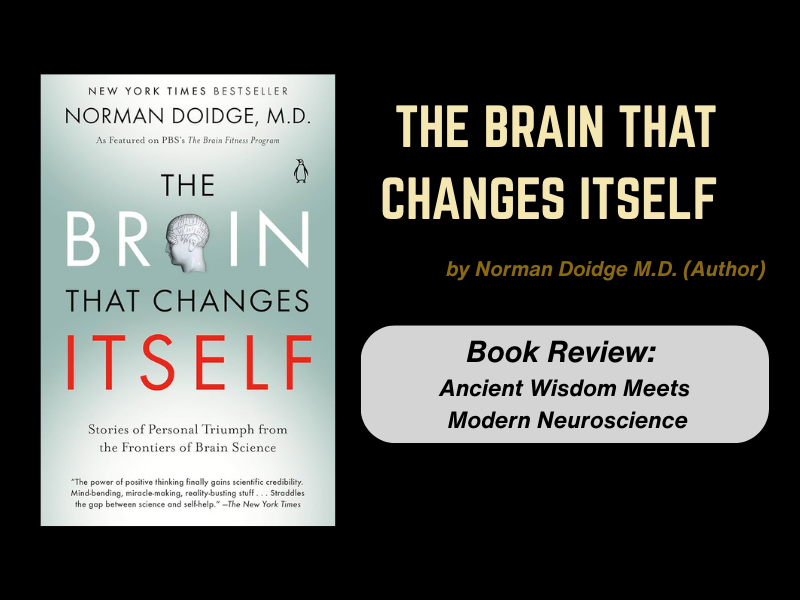
The Brain That Changes Itself review
Category: Book Reviews, Neuroscience, Transformation
Tags: neuroplasticity, brain rewiring, pattern breaking, Sufi wisdom, Stoic philosophy, Buddhist psychology, transformation, self-improvement, metacognition
Author: Nizar Al Haddad, The Grey Hour
When Science Catches Up to the Mystics
At 3 AM, when your patterns are loudest and your defenses are down, you’ve probably wondered: Can I actually change? Or am I stuck running the same code forever?
Norman Doidge’s The Brain That Changes Itself: Stories of Personal Triumph from the Frontiers of Brain Science answers that question with research that would make the Sufi mystics smile knowingly.
They already knew.
The Sufis called it tazkiyah (purification through practice). The Stoics called it askesis (training of the self). The Buddhists called it bhavana (cultivation). Today, we call it neuroplasticity—the brain’s ability to rewire itself through experience and practice.
Same truth. Different language. And now, we have the brain scans to prove it.
If you’ve been struggling with people-pleasing, perfectionism, comparison addiction, or any of the destructive patterns that keep you trapped, this book offers scientific validation for something ancient wisdom traditions have been teaching for millennia: you are not fixed. You can rewire.
What This Book Is Really About
Norman Doidge, a psychiatrist and psychoanalyst, takes readers through a series of case studies that reveal a stunning truth: the brain is not hardwired. It’s more like a river than a rock—constantly reshaping itself based on what flows through it.
The Core Thesis: The brain changes its structure based on the thoughts we think, the actions we take, and the attention we give. Neurons that fire together, wire together. The patterns you repeat become the pathways that dominate. This isn’t metaphor. This is measurable, observable, physical change.
Doidge presents stroke victims who recover “impossible” functions, people born with half a brain who live normal lives, chronic pain sufferers who heal through visualization, and individuals who overcome learning disabilities through targeted practice.
Why It Matters Now: We live in an age of pattern addiction—scrolling, comparing, approval-seeking, perfectionism. These aren’t character flaws. They’re neural pathways carved deep through repetition. Understanding neuroplasticity means understanding that every pattern can be interrupted, every pathway can be rerouted, every habit can be unwired.
Key Insights: Where Ancient Wisdom Meets Brain Science
1. Neurons That Fire Together, Wire Together
What the Book Says: Doidge introduces Donald Hebb’s principle: when two neurons fire simultaneously, the connection between them strengthens. Repeat this firing pattern consistently, and you build a neural superhighway. The more you travel it, the stronger it becomes, the harder it is to choose a different route.
This is why your people-pleasing response feels automatic. Why perfectionism hijacks your projects without permission. Why comparison thoughts appear unbidden when you scroll social media. You’ve practiced these patterns thousands of times. You’ve built neurological infrastructure for them.
The Grey Hour Connection: This is exactly what the Sufis meant by nafs al-ammara—the commanding self that runs automatic patterns. In Sufi psychology, the untrained nafs repeats destructive loops because it’s habituated to them. The path to transformation (tazkiyah) requires conscious interruption of these patterns through muraqaba (self-observation) and mujahadah (spiritual striving).
The Stoics called it prosoche—sustained attention to your thoughts and impulses. Marcus Aurelius in his Meditations writes:
“The soul becomes dyed with the color of its thoughts.” He understood neuroplasticity before we had the vocabulary for it.
Practical Application: This is why The Watcher Protocol is foundational to all transformation work. You cannot rewire what you cannot see. Metacognition—the ability to observe your thoughts without being them—creates the gap between stimulus and response where change becomes possible.
Try This: Set a timer for every two hours today. When it goes off, ask: “What was I just thinking?” Write it down without judgment. You’re beginning to observe the neural patterns that currently run your life. This is Day 1 of rewiring.
2. Use It or Lose It: Neural Darwinism
What the Book Says: Doidge explains how unused neural pathways weaken and eventually disappear—a process called synaptic pruning. The brain is ruthlessly efficient. It strengthens connections you use frequently and eliminates those you don’t.
This cuts both ways. Your destructive patterns stay strong because you keep using them. But it also means that every day you don’t run the old pattern, you’re weakening it. Every time you choose a different response, you’re building a new pathway and letting the old one atrophy.
The Grey Hour Connection: The Buddhist concept of bhavana (mental cultivation) operates on this principle. You become what you practice. The Pali Canon states: “Whatever a person frequently thinks and ponders upon, that will become the inclination of their mind.”
This is why the 30-day protocols (COMING SOON) are structured the way they are. Thirty days isn’t magic—it’s the minimum time needed for consistent practice to begin forming new neural infrastructure while letting old patterns weaken.
Practical Application: If you’re breaking people-pleasing patterns, every time you say “no” without apologizing, you’re weakening the people-pleasing pathway and strengthening the boundary-setting pathway. If you’re breaking perfectionism, every time you ship “good enough” work, you’re pruning perfectionist circuits and growing practical ones.
Try This: Choose one micro-behavior from your dominant pattern (people-pleasing, perfectionism, comparison, etc.). For the next seven days, do the opposite behavior once per day. Track it. Watch the discomfort decrease as the new pathway strengthens. This is neuroplasticity in real time.
3. The Critical Period Myth: You Can Teach an Old Dog New Tricks
What the Book Says: For decades, neuroscience taught that the brain was only plastic during critical developmental periods in childhood. After that, you were essentially fixed. Doidge demolishes this myth with case after case of adults fundamentally rewiring their brains—sometimes in their 60s, 70s, and 80s.
Stroke victims in their 70s regain movement through targeted exercises. Adults with lifelong learning disabilities overcome them through specialized training. The brain remains plastic throughout life, though it requires more focused effort as we age.
The Grey Hour Connection: This validates the central teaching of all contemplative traditions: transformation is always possible. The Sufi path doesn’t have an age limit. Neither does the Stoic discipline or Buddhist practice. At any moment, you can begin the work of changing yourself.
The Persian poet Rumi wrote: “Yesterday I was clever, so I wanted to change the world. Today I am wise, so I am changing myself.” Age doesn’t determine capacity for change. Commitment does.
Practical Application: If you’re 25, 35, 45, or 65 and thinking “I’ve been this way too long to change,” you’re wrong. The research proves it. The mystics knew it. What matters is not how long you’ve run the pattern but whether you’re willing to practice something different starting now.
Try This: Identify your oldest, most entrenched pattern (probably the one you’re most ashamed of). Write this down: “This pattern is not my identity. It’s a neural pathway I can rewire starting today.” Read it daily for a week. Notice what shifts.
4. Attention Shapes Reality: What You Focus on Grows
What the Book Says: Doidge presents research showing that where we direct our attention literally changes brain structure. Musicians who practice specific skills develop enlarged brain regions corresponding to those skills. Taxi drivers in London (who must memorize the entire city) have enlarged hippocampi (the memory center).
But here’s the critical insight: This works for destructive patterns too. If you constantly ruminate on comparison, your brain builds comparison infrastructure. If you obsessively think about approval, you strengthen approval-seeking circuits.
Attention is not neutral. It’s the sculptor’s tool that shapes your brain.
The Grey Hour Connection: This is the heart of meditative practice across all traditions. Samma sati (right mindfulness) in Buddhism. Dhikr (remembrance) in Sufism. Attention (prosoche) in Stoicism.
The practice isn’t about emptying the mind—it’s about training attention. Where you place your awareness, you place your power. Choose wisely, because you’re literally building your future brain with every moment of attention.
Practical Application: This is why doom-scrolling rewires you for anxiety. Why comparison-scrolling rewires you for inadequacy. Why approval-seeking rewires you for external validation. Every scroll is a rep at the neural gym. You’re training, whether you realize it or not.
The question isn’t “Should I train?” The question is “What am I training for?”
Try This: For the next 24 hours, track what captures your attention. Every time you notice yourself dwelling on comparison, approval-seeking, or perfectionism thoughts, mark it. Don’t judge. Just count. At day’s end, multiply by 365. That’s roughly how many reps per year you’re doing. Now you understand why the pattern is so strong.
5. The Paradox of Plasticity: The Brain Can Wire for Good or Ill
What the Book Says: Here’s the uncomfortable truth Doidge doesn’t shy away from: neuroplasticity is morally neutral. The same mechanism that allows healing also enables addiction. The brain that can rewire for resilience can also rewire for rigidity.
Every repetition carves the pathway deeper—whether it’s a healthy practice or a destructive pattern. This means we’re in a constant battle between competing neural pathways, and whichever we feed most consistently wins.
The Grey Hour Connection: This is why all wisdom traditions emphasize vigilance. In Sufism, muraqaba isn’t just observation—it’s watchfulness. The Stoics spoke of being a guardian at the gates of perception. The Buddhists teach appamada (heedfulness)—never becoming complacent about what you allow into consciousness.
Marcus Aurelius knew he was one careless moment from reverting to old patterns: “The impediment to action advances action. What stands in the way becomes the way.” He practiced daily journaling not because he’d mastered Stoicism, but because he knew plasticity cuts both ways.
Practical Application: This is why transformation isn’t a one-time event. It’s a daily practice. The people-pleaser who sets boundaries once will revert unless they practice boundary-setting consistently. The perfectionist who ships one “good enough” project will slip back unless they make it a pattern.
The neural pathways for your old patterns are still there. Weakened, but waiting. The moment you stop practicing the new pattern and relax into autopilot, the old highways are still there, familiar and well-worn.
Try This: After completing a 30-day rewiring protocol (from The Re-Wiring Lab or elsewhere), don’t celebrate by stopping. That’s when the real work begins—maintenance. Schedule a weekly check-in: “Did I run the old pattern this week? If so, where and why? What can I adjust?”
Critical Perspective:
Strengths
1. Accessible Science Doidge translates complex neuroscience into compelling human stories. You’re not reading research papers—you’re meeting people whose lives were transformed by understanding how their brains work.
2. Hope Without Hype Unlike the self-help industrial complex that promises easy transformation, Doidge is honest about the work required. Neuroplasticity isn’t magic—it’s mechanics. Change is possible, but it requires consistent, focused effort.
3. Empirical Validation of Ancient Wisdom For those who need scientific proof before committing to contemplative practices, this book provides it. Every meditation teacher, every Stoic philosopher, every Sufi master was describing neuroplasticity—they just called it something else.
Limitations
1. Heavy on Case Studies, Light on Protocol Doidge shows you what’s possible but doesn’t always tell you how to do it yourself. The book inspires but doesn’t always instruct. This is where frameworks like The Watcher’s Way fill the gap—translating the science into daily practice.
2. Limited Engagement with Contemplative Traditions While Doidge mentions meditation briefly, he doesn’t deeply explore how ancient practices align with neuroplasticity research. He focuses on Western clinical interventions while largely ignoring thousands of years of contemplative neuroscience.
3. Doesn’t Address Modern Pattern Addictions Published in 2007, the book predates the smartphone dopamine crisis. It doesn’t tackle social media comparison, algorithmic manipulation, or digital approval addiction—the exact neural hijacking most relevant to your 3 AM struggles.
Who This Book Is For
- The Skeptic: If you need scientific proof that transformation is possible before committing to the work
- The Chronic Pattern-Runner: If you’ve been stuck in people-pleasing, perfectionism, or comparison and thought “this is just who I am”
- The Ancient Wisdom Practitioner: If you want empirical validation for why meditation, journaling, and contemplative practice actually work
- The Neuroscience Curious: If you want to understand the mechanism behind behavior change beyond pop psychology platitudes
Who Should Skip It: If you’re looking for a step-by-step protocol, this isn’t it. Read The Craving Mind or dive straight into Rewired: 12 Patterns – (coming soon) instead.
The Grey Hour Take: What Neuroscience Forgot (and the Mystics Remembered)
Here’s what fascinates me about The Brain That Changes Itself: it’s a 400-page book that proves what a Sufi could have told you in one sentence: “Man arifa nafsahu faqad arafa rabbahu”—He who knows himself, knows his Lord.
Self-knowledge is neuroplasticity.
The mechanism Doidge describes—attention shaping structure, practice creating pathways, observation enabling choice—is precisely what contemplative traditions have been teaching for millennia. They didn’t have fMRI machines, but they had something better: thousands of years of first-person experimentation.
What the book misses: The transformation isn’t just about rewiring individual patterns. It’s about cultivating metacognitive awareness—the ability to watch your mind watching itself. This is what the Buddhists call sati, the Sufis call muraqaba, and the Stoics call prosoche.
Without this foundational skill, neuroplasticity becomes a game of whack-a-mole: you rewire one pattern, but another pops up. You fix people-pleasing but discover perfectionism underneath. You conquer perfectionism but uncover approval addiction beneath that.
The missing piece: The Watcher Protocol.
Before you rewire any specific pattern, you must develop the capacity to observe patterns in real-time. This is why The Grey Hour places metacognition as foundational to all transformation work. You cannot interrupt what you cannot see. You cannot rewire what you’re unconscious of.
Doidge gives you the what (neuroplasticity is real) and the why (your brain can change). Ancient wisdom gives you the how (daily practice of attention and awareness).
Integration: When you combine Doidge’s research with Sufi self-observation practices, Stoic prosoche, and Buddhist mindfulness, you get a complete transformation system:
- Awareness (Watcher Protocol): Learn to observe your patterns without being them
- Understanding (Neuroplasticity Science): Know why these patterns exist and how they’re maintained
- Practice (30-Day Rewiring Protocols): Apply consistent, focused effort to build new pathways
- Maintenance (Daily Contemplative Practice): Keep the new pathways strong and the old ones weak
Practical Takeaway: If You Remember Only One Thing
Insight: Your brain at 3 AM is not your destiny. It’s a snapshot of your current neural infrastructure—built through years of unconscious practice. Every pattern you hate about yourself is simply a pathway carved through repetition. And every pathway can be rewired through different repetition.
Practice: Start with seven days of The Watcher Protocol:
- Morning (5 min): Notice what patterns are running. Don’t try to change them. Just watch.
- Midday (2 min): When you catch yourself in a pattern, label it: “people-pleasing,” “perfectionism,” “comparison.” Just name it.
- Evening (5 min): Journal on one question: “What pattern ran strongest today, and what was I actually afraid would happen if I didn’t run it?”
Why This Works: You’re building the metacognitive infrastructure that makes all other rewiring possible. The Sufis, Stoics, and Buddhists knew: transformation begins with observation.
Final Verdict
Rating: ⭐⭐⭐⭐⭐ (Essential Reading)
Bottom Line: The Brain That Changes Itself offers scientific validation for what wisdom traditions have taught for millennia—you are not stuck. Read it for the hope. Then practice with The Grey Hour’s protocols for the transformation.
Find the book on Amazon: The Brain That Changes Itself: Stories of Personal Triumph from the Frontiers of Brain Science
Read more about the author: Dr. Norman Doidge, MD
Continue Your Transformation Journey
If The Brain That Changes Itself resonated with you, here are your next steps:
Related Grey Hour Resources:
- The Watcher’s Way: 7-day foundational protocol for developing metacognitive awareness
- Rewired: 12 Patterns Keeping You Stuck: Complete 30-day protocols for people-pleasing, perfectionism, comparison, and more
- The Rewiring Lab: Ongoing articles bridging neuroscience with Sufi, Stoic, and Buddhist practices
Complementary Reading:
- The Craving Mind by Judson Brewer (coming review) – How mindfulness rewires addiction loops
- Atomic Habits by James Clear (coming review) – Practical behavior change mechanics
- Why Buddhism Is True by Robert Wright (coming review) – Buddhist psychology meets evolutionary neuroscience
Frequently Asked Questions
Is The Brain That Changes Itself worth reading? Yes, especially if you need scientific validation that transformation is possible. The book provides compelling evidence that your brain can rewire at any age, supporting what wisdom traditions have taught for centuries about the possibility of fundamental change.
What is neuroplasticity in simple terms? Neuroplasticity is the brain’s ability to reorganize itself by forming new neural connections throughout life. In practical terms: your thoughts, actions, and attention literally change your brain’s physical structure. The patterns you practice strengthen; the ones you abandon weaken. This is how transformation works at the biological level.
How long does it take to rewire your brain? Research suggests that new neural pathways begin forming within days of consistent practice, but meaningful rewiring typically requires 30-90 days of sustained effort. The exact timeline varies based on pattern complexity, consistency of practice, and individual neurology. This is why The Grey Hour’s transformation protocols are structured as 30-day intensive practices—it’s the minimum time needed to establish new neural infrastructure.
Can neuroplasticity help with people-pleasing and perfectionism? Absolutely. People-pleasing and perfectionism are learned neural patterns—automatic responses carved through years of repetition. Neuroplasticity research confirms these patterns can be rewired through consistent practice of different responses. The key is developing metacognitive awareness (watching your patterns) before attempting to change them, which is why The Watcher Protocol is foundational to all transformation work.
At The Grey Hour, we bridge ancient contemplative wisdom with modern neuroscience to help you break the patterns keeping you stuck. Our work is grounded in Sufi, Stoic, and Buddhist traditions, validated by research, and delivered through practical protocols that create real change.
Ready to begin your transformation? Start with The Watcher’s Way—our foundational 7-day protocol for developing the metacognitive awareness that makes all rewiring possible. Read more on the Re-wiring Lab Page you can also read adn doenlow our first free 2 min Watcher Reset Practice.
The Brain That Changes Itself review
- Nizar Al Haddad, The Grey Hour