
Shadow Work | Depth Psychology | Relationships | Art & Psychology
Tags: projection, projection in relationships, Jungian psychology, Magritte, shadow work, Ibn Arabi, relationships, consciousness, The Watcher, ancient wisdom, depth psychology
You Have Never Kissed Who You Think You Have Been Kissing- What Magritte Painted and Jung Explained
René Magritte was thirteen years old when his mother drowned herself in the river near their home in Belgium.
When they found her body, her nightgown had wrapped itself around her face. Whether she had been trying to cover herself, or whether the cloth had simply moved in the current, no one can say. What the young Magritte saw — and what he spent the rest of his life unable to fully leave behind — was the face of someone he loved, and could not reach.
He spent the next fifty years painting this. Not the drowning. The covering. The specific, unbearable psychology of being pressed completely against someone and still not reaching them.
Projection in relationships is not a modern problem. It is not a product of our age of distraction or disconnection. It is as old as love itself — and Magritte understood it before he had the clinical language to name it. What he painted in 1928 is what Jung would spend decades explaining, what Ibn Arabi had already mapped eight centuries earlier, and what most people in intimate relationships are living inside right now without fully recognizing it.
The Painting That Contains the Problem
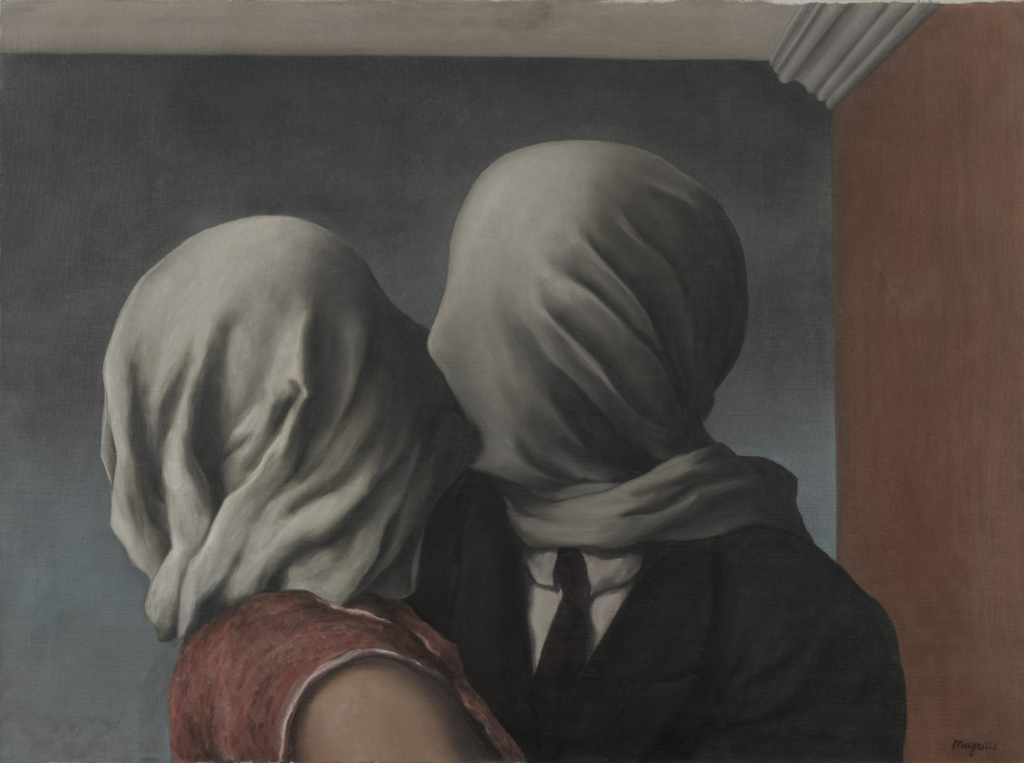
The Lovers shows two people kissing. Both faces are wrapped entirely in white cloth. They cannot see each other. They cannot breathe each other. They are pressing themselves against each other with everything they have, and they are kissing the cloth.
It is, in my view, the most psychologically honest image of romantic love ever made.
When MoMA first exhibited it, viewers described a quality of profound unease that was difficult to locate precisely. The painting is not violent. It shows tenderness. It shows desire. And yet something about it is almost unbearable to look at for long.
What is unbearable is the recognition. Because somewhere in us — in the part that lives below the performance of the relationship and the narrative we construct about who we are to each other — we know the image is accurate.
We have all, at some point, kissed the cloth.
https://www.moma.org/collection/works/79933
What Jung Named and Spent Forty Years Mapping
Projection in relationships is one of the most documented phenomena in depth psychology and one of the least examined in daily life. Carl Jung, who spent decades mapping the architecture of the personal unconscious, described projection as the mechanism by which the unintegrated contents of our own psyche — the qualities, longings, fears, and needs we have not consciously claimed — are placed onto the people in front of us.
We do not fall in love with who someone is. We fall in love with who we have made them. We assemble them from the raw material of our own interior life — our exiled needs become their depth, our unprocessed longing becomes their magnetism, our unfaced fears become the particular danger they represent — and then we respond to the construction as if it were the person.
Jung was careful to note that projection operates in both directions. We project our gold as readily as our shadow. The person you admire most intensely is often carrying a projection of your own exiled potential. The person you fall most urgently in love with is often holding a constellation of your own deepest, most unmet needs.
The problem is not the projection itself. The problem is the moment you mistake the projection for the person. It is kissing the cloth and believing, with genuine feeling and complete sincerity, that you have reached the face.
This is why disappointment in love arrives with such disproportionate force. You are not only mourning who the person turned out to be. You are confronted by the recognition that you were partly responding to your own interior world. The grief is doubled: the loss of the relationship, and the loss of the self-image the projection was sustaining.
https://www.psychologytoday.com/us/basics/projection
The Sufi Who Understood This Eight Centuries Earlier
Ibn Arabi was born in Murcia in 1165, in what is now southern Spain. He wrote more than 350 works on the nature of consciousness, the interior life, and the architecture of the human heart. The Western philosophical tradition largely overlooked him. The Sufi tradition considers him the most complete cartographer of the inner world who ever lived.
His central concept of the qalb — translated inadequately as “heart,” but meaning something closer to the heart as a faculty of direct perception — is one of the most precise pre-modern accounts of what Jung would later name projection. The qalb, Ibn Arabi taught, is a mirror. Its natural function is to see what is actually there — to perceive another person as they are, rather than as our conditioning needs them to be. But that mirror gets coated over time. Not broken. Coated. With every unprocessed wound, every exiled emotion, every belief absorbed before it could be questioned, every layer of self-protection built in a world that required us to be smaller than we were.
A coated mirror does not reflect accurately. It reflects a version of reality filtered through the accumulated residue of a specific, historically-shaped life. And when two coated mirrors are pressed against each other — in marriage, in friendship, in family — what passes between them is not the other person. It is the composite of two lifetimes of unexamined interior history.
https://plato.stanford.edu/entries/ibn-arabi
Magritte painted this in 1928. Ibn Arabi wrote it in the 12th century. They arrived at the same devastating image by completely different routes — one through biographical trauma, one through decades of contemplative practice. When traditions this distant converge on the same precise insight, that convergence is worth paying close attention to.
What Projection Actually Costs in Relationships
The cost of unrecognized projection in relationships is not abstract. It appears in textures you will recognize.
The resentment that arrives disproportionate to what actually happened — because you are not responding to what happened, but to what the pattern has decided it means about who you are and what love always eventually does.
The disappointment larger than the situation — because you are grieving the image as much as the reality.
The inexplicable loneliness inside a relationship that genuinely involves love — the specific, quiet loneliness of being loved for your costume rather than your face.
And the pattern that repeats across different relationships: different person, different circumstances, same essential wound activated in the same essential way. The cloth is the same. Only the person wearing it changes.
Neuroscientist Anil Seth describes conscious experience as a “controlled hallucination” — the brain’s best prediction of reality, constructed from prior models rather than from direct perception. In intimate relationships, this means we are, to a significant degree, responding to our model of the other person. A model built from every prior attachment, every early experience of love and its conditions, every learned equation between closeness and what closeness eventually costs.
The more unexamined that history, the more the model dominates the perception. The more the model dominates, the more we are kissing the cloth.
The Practice That Changes What You Can See
There is a capacity that every serious contemplative tradition identifies as the foundational requirement for genuine inner change. The Sufis called it muraqaba — watchful inner presence, the quality of attention that witnesses without being immediately swept into what it witnesses. The Stoics called it prosoche — disciplined self-attention. The Buddhists called it sati — bare, non-reactive awareness. Modern neuroscience calls it metacognition.
The Grey Hour calls it The Watcher.
The Watcher does not eliminate projection immediately. That is not its function. What it does is create a fraction of interior space — between the trigger and the response, between the perception and the pattern — in which a different question becomes possible.
Not: “Why is this person doing this to me?” But: “What am I bringing to this moment that is shaping what I am perceiving?”
That question, asked honestly in the moment it is relevant, is where the cloth begins to loosen. It is slow work. It is not linear. But it is the only work that reaches what the cloth has been protecting: the actual face of the other person. And, perhaps more importantly, your own.
If this landed with you, the full exploration of projection, the relational shadow, and the complete Watcher methodology is in The Architecture of the Unseen Self — 155 pages mapping exactly where patterns live and what genuinely reaches them.
The Watcher’s Way is the seven-day practice guide for developing the foundational capacity that makes this work possible, one day at a time.
For weekly essays in this territory, The Grey Hour publishes every Sunday on Substack. https://thegreyhour.com/the-watchers-way-collection-books/ or https://thegreyhour.gumroad.com/l/thearchitectureoftheunseenself
The visual and daily exploration continues at @owl.daze on Instagram. https://www.instagram.com/owl.daze
And if this piece raised questions you want to take further, the companion post — on Frida Kahlo’s The Two Fridas and the psychology of what we exile in ourselves to survive pain — is here.
The most radical act in love is not falling. It is staying long enough to remove the cloth. And discovering, when you finally do, that the face you find may be more extraordinary than the image you fell in love with.


Congratulations, Nizar, truly outstanding article. I recognize myself in it more than I would like to admit, to be honest. The image of “kissing the cloth” is haunting because it forces us to ask how often we have loved through the lens of our own longings, wounds, and unfinished stories. I think many of us spend years believing we are seeing another person clearly, only to discover we were also seeing pieces of ourselves reflected back at us.
I love the Ibn Arabi’s mirror. The idea that the heart is not broken but coated by life, grief, fear, and old narratives feels profoundly true. The older I get, the more I realize that love is not only about finding someone who sees us. It is about having the courage to clean the mirror enough to see them as they truly are.
Perhaps that is why disappointment can hurt so much. We are not only grieving the person. We are grieving the beautiful story we wrapped around them, the future we imagined, and sometimes the parts of ourselves we hoped they would heal. Thank you for bringing together Magritte, Jung, and Ibn Arabi so masterfully. Your words reminded me that the deepest intimacy may not be finding the perfect reflection, but slowly removing the cloth and meeting another soul beyond projection, beyond fantasy, and beyond the stories we tell ourselves about love.