

Shadow Work Series – Part 3 | Reading Time: 17 minutes / Part of the Watcher Sereis work and The Re-Wiring Lab Practices
Tags: projection mirror psychology , shadow work, The Watcher, triggers, 3-2-1 process, Carl Jung, Ken Wilber, mentalization, shadow integration, metacognition, relationship triggers, emotional reactivity, pattern recognition, The Grey Hour, Rewiring Lab
The People Who Trigger You Are Your Greatest Teachers
There’s someone in your life right now who irritates you beyond reason. Maybe it’s their arrogance. Their neediness. Their self-righteousness. Their passivity. Their attention-seeking. Their coldness. Whatever it is, just thinking about them creates a visceral reaction in your body—tension, disgust, anger, or contempt.
You’ve probably spent hours mentally cataloging their flaws. You’ve complained about them to friends. You’ve fantasized about confronting them or cutting them off. You’re absolutely certain the problem is them.
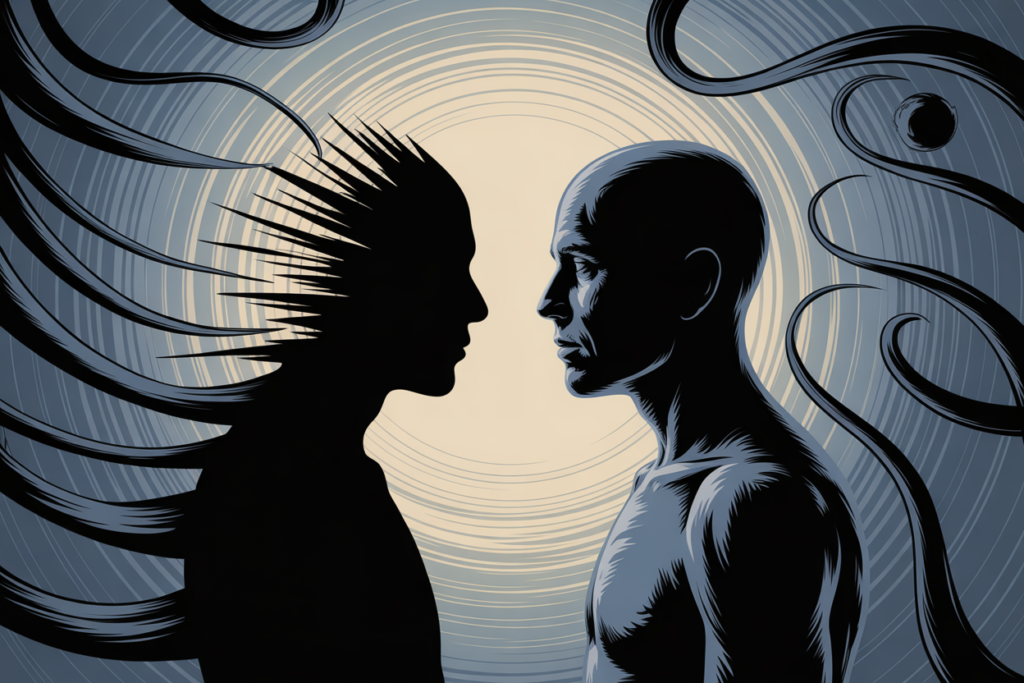
But here’s what The Watcher discovers when it looks deeper: That person isn’t your problem. They’re your mirror.
The qualities that trigger intense emotion in you—the ones you can’t simply disagree with but must actively judge, despise, or obsess over—are almost always pointing directly to your shadow. Not because the other person doesn’t have those qualities (they might), but because your reaction reveals what you’ve rejected in yourself.
This is projection—the unconscious mechanism that keeps your shadow hidden by attributing your disowned qualities to others. And it’s the most powerful teacher you’ll ever encounter for shadow work, if you learn to use it correctly.
The Watcher Discovers Projection: Why You See Yourself Everywhere
Carl Jung spent decades studying projection and discovered something revolutionary: “Everything that irritates us about others can lead us to an understanding of ourselves.”
Not “everything that’s wrong with others.” Not “everything that’s actually their fault.” Everything that irritates us—that creates that special quality of reactive charge, that emotional intensity that seems disproportionate to the situation.
The Mechanism of Projection
Here’s what happens in your psyche when you project:
Step 1: You exile a quality to your shadow (anger, neediness, arrogance, sexuality, power, etc.)
Step 2: You lose conscious access to this quality in yourself. It becomes blind spot material—”I’m not like that.”
Step 3: You become hypersensitive to this quality in others. The Watcher observes: People who display your disowned quality create an immediate, intense reaction.
Step 4: You unconsciously attribute exaggerated versions of this quality to them. The Watcher notices: You see the quality as worse in them than it actually is.
Step 5: You righteously judge, condemn, or obsess over them for having this quality. The Watcher recognizes: The intensity of your reaction is the clue that this is shadow work, not reality assessment.
Jung explained: “Projections change the world into the replica of one’s own unknown face. In the last analysis, therefore, they lead to an autoerotic or autistic condition in which one dreams a world whose reality remains forever unattainable.”
Translation: When you’re caught in projection, you’re not seeing the real person. You’re seeing your own shadow reflected back to you. The world becomes a mirror of what you can’t acknowledge in yourself.
The Neuroscience of Projection and Blind Spots
Dr. Peter Fonagy’s research on mentalization provides the neural basis for projection. His studies demonstrate that the capacity to understand your own mental states directly predicts your ability to understand others. When you can’t recognize your own anger, you misinterpret others’ anger. When you deny your own neediness, you can’t accurately perceive others’ needs.
The mechanism operates through what neuroscientists call “implicit bias”—automatic associations formed outside conscious awareness. Dr. Mahzarin Banaji’s research on the Implicit Association Test shows that you can consciously believe you don’t have a quality while your brain automatically associates that quality with yourself.
Here’s what happens neurologically:
The Suppression Circuit: When you exile a quality (anger, neediness, etc.), the dorsolateral prefrontal cortex actively suppresses activation in regions associated with that quality. You literally can’t see it in yourself—the suppression circuit blocks conscious awareness.
The Projection Circuit: But the suppressed quality remains active in subcortical regions. When you encounter someone displaying this quality, your amygdala activates intensely (threat response), while your anterior cingulate cortex generates the feeling that this quality is “out there” rather than “in here.”
The Confirmation Circuit: Your brain then selectively attends to evidence confirming your projection while filtering out contradictory information. This is confirmation bias in service of shadow maintenance.
The Watcher breaks this circuit by creating space between the automatic reaction and your conscious response. It observes: “I’m having an intense reaction. This intensity is information about me, not just about them.”
What Ancient Wisdom Teaches About Projection
The contemplative traditions discovered projection millennia before neuroscience validated it:
The Sufis taught that every person you meet is a mirror reflecting your inner state. Rumi wrote:
“Everything in the universe is within you. Ask all from yourself.”
The practice of muraqaba (self-observation) specifically includes watching your reactions to others as direct shadow revelation.
[Read more : The Witness Within: Mastering Sufi Muraqaba for Inner Freedom ]
In Sufi teaching, those who trigger you most are your greatest spiritual teachers—they show you exactly where your nafs (ego-self) is still unconscious. The person who irritates you is polishing your heart by revealing what needs to be seen.
The Buddhists developed the practice of using “enemies” as teachers. The Dalai Lama teaches that people who challenge you are more valuable than those who agree with you, because they show you where you’re still attached, still reactive, still unconscious. The enemy is the perfect laboratory for shadow work.
The Buddhist concept of pratītyasamutpāda (dependent origination) suggests that nothing exists independently—your experience of “that annoying person” is co-created by your own shadow projection. The Watcher sees: They’re not inherently annoying. Your shadow is using them as a screen.
The Stoics understood this through the concept of prosoche (attention). Marcus Aurelius wrote:
“Choose not to be harmed—and you won’t feel harmed. Don’t feel harmed—and you haven’t been.”
The Stoics recognized that your reaction is always about your internal state, not the external trigger.
Epictetus taught: “It’s not what happens to you, but how you react to it that matters.” The reaction is where The Watcher finds your shadow.
[Read more: The Inner Citadel: Building Unshakeable Peace in Chaos]
The Watcher’s Projection Recognition System
The Watcher learns to recognize projection through specific signs. Not every judgment is projection—sometimes people are actually behaving badly. But projection has a distinct signature:
Sign #1: Disproportionate Emotional Intensity
What The Watcher Observes: Your reaction is way bigger than the situation warrants. Someone cuts you off in traffic and you’re enraged for an hour. A colleague is slightly self-promoting and you want to write a manifesto about their narcissism.
The Shadow Clue: When the emotional response is disproportionate to the trigger, you’re not just reacting to them—you’re reacting to your own disowned quality being reflected back.
The Watcher’s Question: “Is my reaction matching the situation, or is something else being activated here?”
Sign #2: Obsessive Mental Replay
What The Watcher Observes: You can’t stop thinking about them. You mentally rehearse what you’d say to them. You tell multiple people about how terrible they are. They occupy your mind even when they’re not present.
The Shadow Clue: If you can’t let it go, if it loops compulsively, you’re caught in projection. The obsessive quality reveals that your psyche is trying to process disowned shadow material by locating it “out there.”
The Watcher’s Question: “Why am I giving this so much mental energy? What am I trying to resolve by focusing on them?”
Sign #3: Absolute Certainty of Their Badness
What The Watcher Observes: You have zero empathy for them. No curiosity about their perspective. No sense of your own potential contribution. They’re 100% wrong/bad/toxic. You’re 100% right/good/victimized.
The Shadow Clue: Absolute certainty is always a red flag. When you split reality into “all bad” (them) and “all good” (you), you’re using primitive defense mechanisms to avoid shadow integration.
The Watcher’s Question: “Am I seeing a real person with complexity, or a cardboard cutout I’ve created to hold my disowned qualities?”
Sign #4: The Pattern Repeats
What The Watcher Observes: This isn’t the first person who’s been “like this.” You keep encountering arrogant people. Or needy people. Or controlling people. The faces change but the pattern remains.
The Shadow Clue: If the same type of person keeps showing up in your life, it’s not cosmic bad luck. It’s your shadow using the external world to try to get your attention. The pattern repeats until you see what you’re projecting.
The Watcher’s Question: “Have I encountered this quality in multiple people? What’s the common denominator?” (Hint: The common denominator is you.)
Sign #5: Others Don’t React the Same Way
What The Watcher Observes: That person who drives you crazy doesn’t bother your friends the same way. Or they bother your friends in completely different ways. Everyone sees something different.
The Shadow Clue: If your reaction is unique to you, it’s revealing your unique shadow material. Different people project different shadows onto the same screen.
The Watcher’s Question: “Are others having the same reaction I’m having? If not, what does that reveal about my projection?”
The 3-2-1 Shadow Process: Turning Projection Into Integration
The Watcher uses a powerful technique developed by Ken Wilber called the 3-2-1 Process. This practice systematically transforms projection (seeing shadow in others) into integration (owning shadow in yourself).
Stage 1: Face It (3rd Person – “They/Them”)
The Watcher’s Practice:
- Identify the Trigger: Who triggers you? Name the person and the quality that creates the reaction. Be brutally honest.
- “My colleague Sarah is so arrogant and self-promoting.”
- “My partner is so needy and clingy.”
- “That person at the coffee shop was so cold and dismissive.”
- Feel the Reaction: The Watcher observes the full emotional charge. Don’t minimize it. Don’t spiritually bypass it with “I shouldn’t judge.” Feel it completely.
- Describe the Quality: The Watcher names exactly what bothers you about them. What do they do? How do they act? Be specific and detailed. Write it out.
Neuroscience: You’re activating the neural networks associated with the disowned quality while keeping it “out there.” This prepares the brain for the reintegration work that follows.
Stage 2: Talk to It (2nd Person – “You”)
The Watcher’s Practice:
- Address the Projection Directly: The Watcher now speaks directly to the quality as if it were a person. Not the actual person who triggered you, but the quality itself personified.
- Dialogue: Write a dialogue. The Watcher asks the disowned quality questions:
- “You (arrogance), why do you exist?”
- “You (neediness), what are you trying to accomplish?”
- “You (coldness), what purpose do you serve?”
- Listen for Response: Let the quality answer. This isn’t make-believe—you’re accessing parts of your psyche that have been split off. The answers that emerge often surprise you.
- Explore the Relationship: The Watcher asks: “What’s our relationship? When have I encountered you before? What are you teaching me?”
Neuroscience: You’re creating neural integration between the suppressed quality (subcortical activation) and conscious awareness (prefrontal activation). The dialogue format activates Broca’s area (speech production) and Wernicke’s area (speech comprehension), creating new pathways for integration.
Stage 3: Be It (1st Person – “I/Me”)
The Watcher’s Practice – This is where transformation happens:
- Own the Quality: The Watcher now speaks as the disowned quality in first person:
- “I am arrogant. I promote myself. I believe I’m superior.”
- “I am needy. I want attention and validation. I fear abandonment.”
- “I am cold. I create distance. I protect myself through disconnection.”
- Feel It Fully: The Watcher guides you to actually feel what it’s like to embody this quality. Not intellectually understand it—actually be it for a moment.
- Discover the Exiled Part: The Watcher asks while you’re embodying the quality:
- “When was I exiled?”
- “What purpose do I serve?”
- “What am I protecting?”
- “What happens when I’m integrated instead of projected?”
- Find the Gift: The Watcher discovers what this quality offers when integrated:
- Arrogance integrated = Healthy confidence and self-worth
- Neediness integrated = Capacity for intimacy and connection
- Coldness integrated = Healthy boundaries and self-protection
Neuroscience: You’re completing the integration circuit. The quality shifts from “out there” (other people) to “in here” (owned as part of self). The default mode network (self-referential processing) reconfigures to include the previously exiled quality. This is neuroplasticity in action—you’re literally rewiring your sense of self.
The 30-Day “Trigger as Teacher” Protocol
The Watcher systematically uses your daily triggers to accelerate shadow integration. This protocol transforms projection from unconscious mechanism into conscious teaching.
Week 1: Trigger Inventory
Daily Practice (10 minutes):
- Evening Review: The Watcher reviews the day. “Who triggered me today? What quality in them created a reaction?”
- Intensity Rating: Rate the emotional charge 1-10. The Watcher notes: Intensity reveals shadow proximity. The stronger the charge, the closer to your shadow core.
- Quality Naming: The Watcher precisely names the quality that triggered you. Not vague (“they were annoying”) but specific (“they were dismissive and cold”).
- Pattern Recognition: By day 7, The Watcher observes patterns. “Do certain qualities repeatedly trigger me? What’s the common thread?”
- Journal: Document all triggers, ratings, and patterns.
The Watcher’s Discovery by Day 7: “My top 3 triggers are _______. These qualities appear in multiple people. The pattern is revealing something about my shadow.”
Week 2: The Mirror Practice
Daily Practice (15 minutes):
- Choose One Trigger: The Watcher selects the person/quality that triggered you most strongly today.
- The Mirror Question: The Watcher asks with genuine curiosity (not self-judgment): “Where do I have this quality in myself? Not necessarily in the same form, but somewhere, somehow?”
- Shadow Archaeology: The Watcher investigates:
- “When have I been like this?”
- “Where do I express this quality but don’t acknowledge it?”
- “What part of me that I’ve exiled looks like this?”
- The Reframe: The Watcher practices saying: “This person isn’t doing anything TO me. They’re doing something FOR me—showing me my shadow.”
- Gratitude Practice: The Watcher thanks the trigger (silently) for revealing what you couldn’t see alone.
- Journal: Document what The Watcher discovered in the mirror.
The Watcher’s Discovery by Day 14: “When I’m honest, I can see I have _______ in myself. I express it by _______. I’ve kept this hidden because _______.”
Week 3: The 3-2-1 Deep Dive
Daily Practice (20 minutes):
- Select One Major Trigger: The Watcher chooses the person/quality with the strongest charge from your inventory.
- 3rd Person – Face It: Describe them and the triggering quality in detail. Feel the full charge.
- 2nd Person – Talk to It: Write a dialogue with the quality. Let it speak to you. Listen for what it’s trying to teach.
- 1st Person – Be It: Speak as the quality: “I am _______.” Embody it. Feel what it’s like. Discover its purpose and gift.
- Integration Statement: The Watcher completes this: “The quality of _______ that I’ve been projecting onto _______ is actually my disowned _______. When integrated, this quality offers me _______.”
- Sit with Integration: The Watcher simply observes what it feels like to own this quality instead of project it.
The Watcher’s Discovery by Day 21: “I’ve been projecting _______. This quality is part of me. Its gift is _______. Integration feels like _______.”
Week 4: Living Without Projection
Daily Practice (20 minutes):
- Morning Projection Preview: The Watcher anticipates: “Today I might encounter people displaying _______. I recognize this as mirror, not attack.”
- Real-Time Watcher Practice: Throughout the day, when triggered:
- Pause: The Watcher notices the reaction arising
- Name: “There’s the trigger. There’s my reaction.”
- Mirror: “What’s this showing me about myself?”
- Choose: Respond from integration, not projection
- The 90/10 Rule in All Interactions: The Watcher remembers: When triggered, they’re 10% responsible (they did something), you’re 90% responsible (your shadow activated). Address the 10% if needed, but work with your 90%.
- Evening Integration Review:
- Where did I catch projection in real-time today?
- Where did I respond from integration instead of reaction?
- What’s shifting as I own my projections?
- Weekly Deep Reflection:
- What patterns have I been projecting?
- How has my experience of “difficult people” changed?
- What qualities am I integrating?
- What’s now available to me that wasn’t before?
The Watcher’s Discovery by Day 30: “The people who triggered me haven’t changed, but my relationship to them has. I see mirrors instead of enemies. I see teachers instead of problems. I’m less reactive, more curious. I’m owning qualities I spent years projecting. This is freedom.”
When Projection Ends: The Watcher’s Liberation
After sustained projection work, The Watcher observes a profound shift. You don’t stop having reactions to people—you’re not a robot. But the quality of your reactions changes fundamentally.
What Changes When You Stop Projecting
Before Projection Work:
- People seem inherently irritating/flawed/wrong
- You need them to change so you can feel okay
- Triggers control your emotional state
- You spend energy managing, avoiding, or fighting “difficult people”
- Relationships feel like battlegrounds
- You’re righteously certain of others’ flaws
After Projection Work:
- People are complex, not cardboard cutouts
- Their behavior is information about them, not attack on you
- Triggers are interesting data about your remaining shadow
- You spend energy on integration, not on changing others
- Relationships feel like mirrors
- You’re curious about others’ perspectives
The Liberation The Watcher Discovers:
- You’re no longer at the mercy of other people’s behavior
- Your peace doesn’t depend on people being different
- You have access to the full range of human qualities
- You’re more authentic because you’re more whole
- You’re more compassionate because you’ve met your own darkness
- You’re freer because projection no longer imprisons you
The Paradox of Integration
The Watcher observes this paradox: As you integrate your projections, the people who triggered you don’t necessarily change, but they also don’t trigger you anymore.
Sometimes they do change—when you stop projecting, you relate differently, and they respond to your actual presence rather than your projective field. Sometimes they don’t change—they’re still who they’ve always been, but you’re no longer caught in reactive patterns with them.
Either way, you’re free. Not because the world became perfect, but because you stopped needing it to be anything other than what it is.
Jung understood this: “Until you make the unconscious conscious, it will direct your life and you will call it fate.”
The Watcher makes projection conscious. Fate becomes choice. Enemies become mirrors. Triggers become teachers.
The Watcher’s Ongoing Practice
Projection work isn’t a one-time achievement—it’s an ongoing practice. The Watcher maintains vigilance:
Daily Micro-Practice (2 minutes): When anyone triggers you today, pause:
- Notice the reaction
- Ask: “What might I be projecting?”
- Return to presence
Weekly Review (15 minutes):
- Who triggered me this week?
- What patterns am I noticing in my projections?
- Which shadow qualities am I still projecting?
- Where am I making progress in integration?
Monthly Deep Dive (60 minutes):
- Choose one person who consistently triggers you
- Do full 3-2-1 Process
- Journal the integration
- Notice how the relationship shifts
The Watcher Knows: Every person you meet is showing you something about yourself. Some show you what you’ve integrated. Some show you what you’ve rejected. All are teachers if you’re willing to learn.
What The Watcher Has Discovered about the Projection Mirror Psychology
After consistent projection work, The Watcher arrives at these truths:
About Projection:
- You see your shadow everywhere until you own it nowhere
- The intensity of your reaction is proportional to the proximity to your core shadow
- Projection is unconscious until The Watcher makes it conscious
- Everyone you judge is teaching you about yourself
- The pattern repeats until you see what you’re projecting
About Integration:
- Owning your projections is more liberating than being right about others’ flaws
- What you make conscious can be worked with; what stays unconscious controls you
- The 3-2-1 Process transforms enemies into mirrors and mirrors into teachers
- Integration isn’t about becoming perfect—it’s about becoming whole
- When you own your shadow, projection stops imprisoning you
About Freedom:
- You’re only as free as your capacity to see your projections
- People who trigger you are giving you gifts, if you’re willing to unwrap them
- The world stops being hostile when you stop projecting hostility
- Relationships transform when projection ends
- Liberation comes from within, never from others changing
The Deepest Truth:
You’ve been looking for yourself in everyone you meet. The people you judge harshly are showing you what you’ve rejected in yourself. The people you admire excessively are showing you what you haven’t claimed in yourself.
The Watcher sees the truth: There are no enemies, only mirrors. There are no attacks, only teachings. There are no irritating people, only invitations to integration.
Every person is a projection screen until The Watcher makes them real.
Every trigger is a prison until The Watcher makes it a teacher.
Every judgment is blindness until The Watcher makes it sight.
Continue the Shadow Work Journey
This is Part 3 of The Grey Hour Shadow Work Series.
- Part 1: The Gold in Your Darkness (shadow recognition and integration)
- Part 2: Meeting Your Inner Saboteur (protective patterns and transformation)
- Part 3: The Projection Mirror (using triggers as shadow teachers)
Coming Next:
- Part 4: Shadow Work in Relationships (intimate partnerships as shadow laboratories)
- Part 5: The Cultural Shadow (inherited patterns and collective trauma)
- Part 6: The Body Holds the Shadow (somatic integration)
- Part 7: The Creative Shadow (transforming shadow into creative power)
For complete Watcher protocols and systematic rewiring practices, visit The Rewiring Lab.
Follow@owl.daze & https://substack.com/@thegreyhour for daily Watcher wisdom.
Tags: projection mirror psychology, shadow work, The Watcher, triggers, 3-2-1 process, Carl Jung, Ken Wilber, mentalization, shadow integration, metacognition, relationship triggers, emotional reactivity, pattern recognition, The Grey Hour, Rewiring Lab

Dear Nizar, I really loved this blog. It’s one of those writings that makes you pause and look at your own reactions differently. The way you explain that the people who trigger us are often mirrors of our own shadow is very powerful. I’ve caught myself doing exactly that, replaying a moment and realizing later that the charge was coming from somewhere inside me. Your explanation of the projection mechanism is very clear and grounded, that part made me reflect on how easily we judge without realizing we might be looking at our own blind spots. Through the 3-2-1 process, what once felt like enemies become mirrors, and those mirrors become teachers. This is very insightful and honestly very useful, Nizar, outstanding write, I am genuinely impressed. Congratulations!
Thank you so much Sofia for this thoughtful reflection. What moves me is your recognition that you’ve caught yourself doing exactly this—replaying a moment and realizing later that the charge was coming from somewhere inside you. This awareness itself is the beginning of transformation; once you see the pattern, you can start to relate to it differently.
Your appreciation for the explanation of projection and how easily we judge without realizing we might be looking at our own blind spots—this tells me the work is landing in a meaningful way. The 3-2-1 process exists precisely to help us make this shift from seeing triggers as enemies to recognizing them as mirrors, and ultimately as teachers.
Thank you for taking the time to engage so thoughtfully with the piece and for sharing what resonated with you. It helps me understand what’s most useful to readers. I’m glad it gave you new ways to look at your own reactions.
With appreciation,
Nizar