
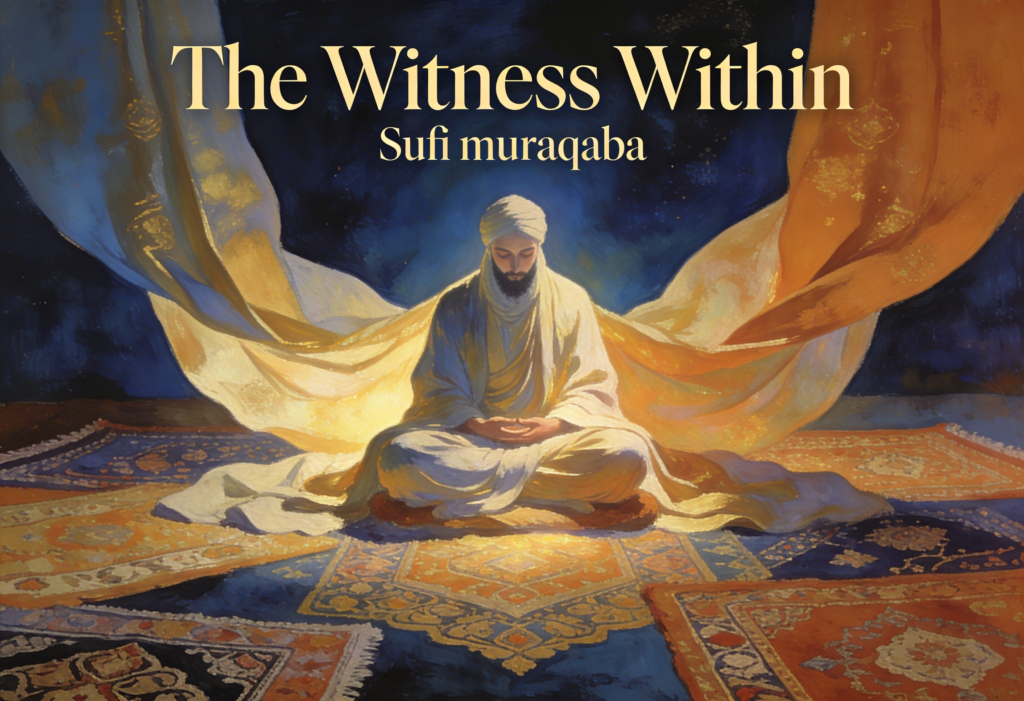
Category: Sufi Wisdom | Reading Time: 17 minutes
Tags: Sufi Muraqaba, Sel-Observation, Inner Freedom, Islamic Mystism, Mindsight, Abu Hamid Al-Ghazali, Muraqabat Al-Nafs, Muraqabat al-Qalb, Muraqabat al-Sirr, Ghafla, Ghurur, Hawa, Kibr, ego Observation, Weekly Practice.
Introduction: The Revolutionary Act of Self-Observation
Muraqaba—the Sufi practice of vigilant self-observation—is perhaps the most misunderstood yet transformative discipline in Islamic mysticism. Often translated as ‘meditation’ or ‘contemplation,’ these terms fail to capture its essence. Muraqaba isn’t about emptying the mind or achieving blissful states. It’s about developing what the Sufis call ‘the witness’—an inner observer that watches the movements of consciousness without being swept away by them.
This ancient practice anticipates modern psychology’s most significant discoveries. What the Sufis called muraqaba, contemporary neuroscience identifies as ‘metacognition’—the ability to observe and regulate one’s own mental processes. Dr. Stephen Fleming at University College London has demonstrated that metacognitive capacity predicts not just self-awareness, but decision-making quality, emotional regulation, and even life satisfaction. His research shows that the brain’s prefrontal cortex—particularly the anterior prefrontal cortex—activates during metacognitive tasks, creating a neural ‘watching’ mechanism.
The revolutionary insight of muraqaba is this: You are not your thoughts. You are not your emotions. You are not your impulses. You are the awareness that observes all of these. This distinction—between the stream of consciousness and the consciousness observing the stream—is the foundation of inner freedom. Without it, you’re a puppet to every passing thought and feeling. With it, you become the author of your internal experience.
Dr. Dan Siegel, clinical professor of psychiatry at UCLA, describes this capacity as ‘mindsight’—the ability to perceive the mind itself. His interpersonal neurobiology research demonstrates that this observational capacity strengthens neural integration, linking distinct brain regions into coherent networks. The result? Enhanced emotional regulation, improved relationships, and what Siegel calls ‘response flexibility’—the space between stimulus and response that Viktor Frankl identified as the essence of human freedom.
Abu Hamid al-Ghazali, the 11th-century philosopher-mystic who synthesized Islamic law with Sufi practice, wrote:
“The self must be watched more strictly than a thief or an enemy. The moment you relax your vigilance, it will deceive you and lead you astray.”
But muraqaba isn’t hostile self-surveillance or paranoid self-monitoring. It’s compassionate awareness—watching yourself with the same gentle curiosity you’d bring to observing a child at play. You’re not judging or controlling; you’re witnessing. And in that witnessing, transformation naturally unfolds.
Contemporary mindfulness research, pioneered by Dr. Jon Kabat-Zinn and expanded by psychologists like Dr. Kristin Neff, validates what Sufis practiced for centuries: non-judgmental self-observation reduces rumination, decreases anxiety and depression, and increases psychological flexibility. But the Sufis went further—they didn’t just observe thoughts; they observed the observer. They developed meta-metacognition, watching the watcher, until only witnessing remained.
What makes muraqaba radical isn’t its technique—it’s its promise. Master this practice, and you master yourself. Not through force or suppression, but through clear seeing. You don’t fight your patterns; you witness them until they lose their grip. You don’t battle your ego; you observe it until you recognize it’s not you.
The Three Dimensions of Muraqaba
The Sufi masters distinguished three levels of muraqaba, each building upon the previous, each offering deeper liberation:
1. Muraqabat al-Nafs (Observation of the Ego-Self)
This is the foundational practice—watching the nafs, the ego-self with its endless desires, fears, and stories. The nafs operates like what Freud later called the ‘id’—a bundle of unconscious drives seeking satisfaction. But where Freud saw these drives as primary reality, the Sufis saw them as passing phenomena that could be observed.
Neurologically, this corresponds to monitoring the limbic system’s activity—the amygdala’s fear responses, the nucleus accumbens’ craving signals, the anterior cingulate cortex’s conflict detection. Research by Dr. Matthew Lieberman at UCLA shows that simply labeling emotions (‘I feel angry’) activates the prefrontal cortex and reduces amygdala activation. This is muraqabat al-nafs in action: witnessing emotion transforms it.
At this level, you practice noticing:
• When desire arises: ‘Ah, craving is present.’
• When aversion emerges: ‘Resistance is here.’
• When ego inflates: ‘Pride is operating.’
• When patterns repeat: ‘This is the familiar pattern.’
Rumi captured this observation:
“The self is like a cloud that hides the sun. Watch the cloud; don’t become the cloud. The sun was always there.”
The practice isn’t to eliminate these movements—that’s impossible and creates new problems. It’s to see them clearly without identification. ‘I am angry’ becomes ‘Anger is present.’ ‘I am anxious’ becomes ‘Anxiety is arising.’ This grammatical shift represents a profound psychological transformation: dis-identification from mental content.
Practice: The Hourly Check-In
Set an alarm for every waking hour. When it sounds, pause and conduct a rapid internal scan:
• What emotion is predominant right now?
• What desire is operating?
• What story is the mind telling?
• Is this state serving my highest values?
Don’t judge or change anything—just witness. Over weeks, this builds the neural pathway of observation, strengthening what neuroscientists call the ‘salience network’—the brain regions that determine what deserves attention.
2. Muraqabat al-Qalb (Observation of the Heart)
The second dimension observes the qalb—the heart, which the Sufis understood as the seat of intuition, spiritual knowing, and deeper truth. While the nafs is reactive and surface-level, the qalb connects to reality beyond ego.
This aligns with research on ‘heart intelligence’ by the HeartMath Institute. Dr. Rollin McCraty’s studies show that the heart’s electromagnetic field is 60 times greater in amplitude than the brain’s, and the heart sends more signals to the brain than vice versa. These cardiac signals influence emotional processing, decision-making, and even perception. The Sufis, through centuries of introspection, discovered what we’re now measuring with EKG and fMRI.
At this level, you learn to distinguish between ego-voice and heart-voice:
• Ego-voice is anxious, grasping, comparative: ‘What will they think? I need this to be happy. I’m not enough.’
• Heart-voice is quiet, knowing, spacious: ‘This feels aligned. Something here isn’t true. Let go.’
Ibn Arabi, the Andalusian mystic, taught:
“The heart has eyes that see what the physical eyes cannot perceive, ears that hear what physical ears cannot detect, and a tongue that speaks without words.”
The qalb speaks through what we might call somatic intelligence—gut feelings, bodily knowing, the sense of rightness or wrongness that precedes rational analysis. Neuroscientist Antonio Damasio’s ‘somatic marker hypothesis’ demonstrates that bodily states guide decision-making, often more accurately than conscious reasoning. The Sufis systematized accessing this intelligence through muraqabat al-qalb.
Practice: Heart Inquiry
When facing any decision, after rational analysis, take three minutes for heart inquiry:
1. Place your hand over your heart
2. Breathe slowly, bringing attention to the heart center
3. Hold the question gently: ‘What does my heart know about this?’
4. Wait for the response—not thoughts, but feeling-knowing
5. Notice: Does the body expand or contract? Does breath deepen or shallow? Does peace or agitation arise?
The heart’s guidance doesn’t always match ego’s preferences. It might say ‘end this relationship’ when ego wants security, or ‘pursue this path’ when ego wants safety. Learning to trust heart-knowing over ego-preference is the work of this dimension.
3. Muraqabat al-Sirr (Observation of the Secret)
The deepest dimension—observing the sirr, the ‘secret’ or innermost consciousness. Here, you’re not watching thoughts or feelings; you’re watching the watcher. You’re observing awareness itself. This is what philosophers call ‘consciousness of consciousness’ or what Sufis call ‘the eye through which God sees.’
Neuroscience has limited tools to study this level—it’s the substrate beneath neural activity. But contemplative neuroscientist Dr. Zoran Josipovic has documented what he calls ‘nondual awareness states’ where the experience of observing and being observed collapse into a unified field. Brain imaging shows dramatic changes: the default mode network (sense of separate self) quiets, while whole-brain integration increases.
Meister Eckhart, whose Christian mysticism paralleled Sufi teaching, described this:
“The eye with which I see God is the same eye with which God sees me. My eye and God’s eye are one and the same—one in seeing, one in knowing, one in loving.”
At this level, subject and object dissolve. There’s no longer ‘you’ watching ‘your mind.’ There’s just witnessing—impersonal, spacious, complete. Thoughts arise and dissolve in awareness like waves in ocean. You are the ocean, not the wave.
Practice: Awareness of Awareness
Sit quietly. Instead of watching breath or sensations, ask: ‘What is aware of the breath? What is aware of sensations? What is aware of thoughts?’
Keep tracing awareness back to its source. You’ll find you can’t locate awareness—it has no position, no boundary, no quality. Yet it’s undeniably present. Rest as that sourceless awareness.
This practice is subtle and can take years to stabilize. Don’t rush it. Master levels one and two first.
The Four Enemies of Muraqaba (And How to Overcome Them)
The Sufi masters identified four primary obstacles that derail self-observation:
Enemy 1: Ghaflah (Heedlessness)
This is spiritual sleep—going through life on autopilot, completely identified with thought streams, never questioning the narrative. Most people spend entire lives in ghaflah, never once stepping back to observe their mental processes.
Contemporary psychology calls this ‘automaticity.’ Dr. Timothy Wilson’s research suggests that 95% of our behavior is unconscious. We’re automatons executing programs written by genetics, conditioning, and trauma, rarely activating conscious choice.
Al-Ghazali warned:
“The worldly man is asleep. Death is his awakening. But why wait for death to wake from the dream?”
The antidote: Remembrance practices (dhikr). Set environmental cues—a bracelet, phone wallpaper, doorway ritual—that trigger the question: ‘Am I present right now, or lost in thought?’ The Sufis used prayer times as built-in remembrance triggers, interrupting automaticity five times daily.
Enemy 2: Ghurur (Self-Deception)
The ego’s genius is disguising itself. You think you’re observing objectively, but you’re actually rationalizing, justifying, defending. The watched self performs for the watcher, creating elaborate justifications for every impulse.
This aligns with research on ‘confirmation bias’ and ‘motivated reasoning’ by psychologists like Dan Kahan. We don’t objectively assess information; we selectively attend to what confirms existing beliefs. Even in ‘self-observation,’ we unconsciously filter what we’re willing to see.
Psychoanalyst Karen Horney described this mechanism:
“The neurotic has no real self-observation. He creates an idealized image of himself and mistakes this fantasy for reality.”
The antidote: Radical honesty check. Ask yourself regularly: ‘Am I observing to understand, or to justify?’ ‘Am I willing to see what I don’t want to see?’ The Sufis practiced with a sheikh (spiritual guide) who could reflect back the self-deceptions they couldn’t see. In modern terms: work with a skilled therapist or truth-telling friend who permission to challenge your narratives.
Enemy 3: Hawa (Following Desire)
You observe that anger is arising, but instead of witnessing it, you justify acting on it. You notice craving for distraction, but instead of staying present with discomfort, you reach for your phone. Observation without dis-identification is useless.
This is what psychologists call ‘insight without behavior change.’ Research by Dr. Timothy Pychyl on procrastination shows that people often have perfect insight into their patterns yet continue them unchanged. Knowing doesn’t transform; witnessing without reactive engagement does.
The Qur’an addresses this:
“Have you seen the one who takes his own desire as his god? Would you be a guardian over him?” (Qur’an 25:43)
The antidote: The pause practice. Between observation and action, insert a mandatory pause. Notice anger—pause for three breaths before responding. Notice craving—pause for ten seconds before acting. This gap, what Viktor Frankl called ‘the space between stimulus and response,’ is where freedom lives. Neuroscience shows this pause activates prefrontal regions that can inhibit limbic impulses.
Enemy 4: Kibr (Pride/Spiritual Ego)
The subtlest trap: becoming proud of your observational capacity. ‘Look how aware I am! I’m more conscious than others.’ The ego co-opts muraqaba, turning it into another achievement to inflate self-image.
This is what Buddhist teacher Chogyam Trungpa called ‘spiritual materialism’—using spiritual practice to reinforce ego rather than dissolve it. Contemporary research on ‘moral licensing’ by psychologist Anna Merritt shows that people who engage in virtuous behavior often give themselves permission to be less virtuous afterward. The same mechanism operates spiritually: ‘I meditated today, so I can be judgmental now.’
Rumi warned:
“The ego’s favorite disguise is the spiritual seeker. Watch for the one watching. Is there pride in your humility?”
The antidote: Observe the observer. Notice when pride arises about your practice. ‘Ah, spiritual pride is present.’ Don’t judge it—that’s just more pride. Simply witness it with the same neutral attention you bring to everything else. The Sufis practiced regular confession of their subtle arrogance to their sheikh, keeping spiritual ego in check.
The 30-Day Sufi Muraqaba Intensive
This protocol builds observational capacity systematically, starting with accessible practices and progressing to subtler dimensions:
Week 1: Muraqabat al-Nafs (Ego Observation)
Morning (5 minutes): Sit quietly. Watch thoughts arise without following them. Label each: ‘planning,’ ‘remembering,’ ‘judging,’ ‘worrying.’ Don’t engage—just label and release.
Throughout Day: Set hourly alarms. Pause and ask: ‘What emotion is present? What desire? What story?’ Journal briefly.
Evening (5 minutes): Review the day. When did you lose awareness? When did you operate on autopilot? No judgment—just observation.
Week 2: Shadow Observation
Continue Week 1 practices. Add:
Trigger Tracking: Notice what triggers reactivity. When someone irritates you, pause: ‘What in them am I rejecting in myself?’ When you feel superior, ask: ‘What insecurity is this compensating for?’
Motive Investigation: Before significant actions, pause and ask: ‘What’s my real motivation here? Am I serving or seeking? Giving or taking? Acting from love or fear?’
Week 3: Muraqabat al-Qalb (Heart Observation)
Continue previous practices. Add:
Heart Inquiry Practice: Before decisions, spend 3 minutes in heart-centered awareness (hand on heart, slow breathing). Ask: ‘What does my heart know?’ Trust somatic wisdom over mental chatter.
Body Scanning: Multiple times daily, drop into body awareness. Where is tension held? What is the body communicating? The body is the heart’s voice.
Week 4: Muraqabat al-Sirr (Awareness of Awareness)
Continue all previous practices. Add:
Witnessing Practice: 10 minutes daily. Instead of watching content (thoughts/feelings), watch the watcher. Ask: ‘What is aware right now?’ Rest as awareness itself.
Meta-Observation: Throughout day, notice: ‘Who is observing this observation?’ Keep tracing awareness to its source.
By Day 30: You should notice: increased space between stimulus and response, decreased reactivity, clearer recognition of patterns, ability to watch difficult emotions without being consumed, and moments of witnessing consciousness becoming primary.
Integration: Living as the Witness
Muraqaba isn’t meant to be confined to practice sessions. The Sufis aimed for continuous witnessing—what they called “hal”, a permanent state of awakened awareness. While “hal” is rare, you can cultivate what’s called ‘intermittent mindfulness’—regular returns to witnessing throughout your day.
The goal isn’t to be perfectly aware every moment. That’s impossible and would be neurologically exhausting. The goal is to develop such strong observational neural pathways that witnessing becomes your default response to challenge.
Someone criticizes you → automatic witness activation: ‘Ah, defensive reaction arising.’
Anxiety floods in → immediate recognition: ‘Anxiety is present. I am not the anxiety.’
Desire grabs you → instant awareness: ‘Craving is operating. Interesting.’
This automaticity of awareness—where witnessing becomes as reflexive as breathing—is the fruit of sustained practice. Neuroscientist Dr. Amishi Jha’s research on attention training shows that consistent practice creates lasting changes in brain structure, particularly in attention networks and self-referential processing regions.
Hafiz, the Persian mystic poet, described the liberated state:
“I have learned so much from God that I can no longer call myself a Christian, a Hindu, a Muslim, a Buddhist, a Jew. The Truth has shared so much of Itself with me that I can no longer call myself a man, a woman, an angel, or even pure Soul. Love has befriended me so completely it has turned to ash and freed me of every concept and image my mind has ever known.”
The Promise and the Practice
The Sufis made an extraordinary claim: Master muraqaba, and you master existence. Not by controlling life, but by transcending identification with its movements. You become like the sky—vast, spacious, unaffected by the clouds passing through.
The promise isn’t that life becomes painless. Pain is inevitable—it’s part of embodied existence. The promise is that suffering becomes optional. When you’re no longer identified with the pain, when you witness it from spacious awareness, it loses its power to overwhelm you.
Contemporary psychology validates this. Dr. Steven Hayes’ Acceptance and Commitment Therapy (ACT) is built on the same principle: psychological flexibility through defusion from thoughts. His research shows that those who can observe their mental content without fusion experience significantly less distress, even when facing identical circumstances to those who remain identified.
But start where you are. Don’t aim for mystical states or perfect awareness. Just begin watching. Notice one thought today without following it. Observe one emotion without becoming it. Catch one automatic pattern before it executes.
As you strengthen the witness, everything shifts. Not suddenly, but gradually—like dawn breaking imperceptibly until suddenly the world is illuminated.
Al-Ghazali concluded his teachings on muraqaba:
“Know that self-observation is the foundation of the spiritual path. Without it, all other practices are like building a house on sand. But with it, the smallest action becomes worship, the briefest moment becomes eternity, and the observing self dissolves into the Observed.”
━━━━━━━━━━━━━━━━
References and Further Reading
Academic Sources:
• Fleming, S. M., et al. (2010). Relating introspective accuracy to individual differences in brain structure. Science, 329(5998), 1541-1543.
• Siegel, D. J. (2010). Mindsight: The New Science of Personal Transformation. Bantam.
• McCraty, R., & Childre, D. (2010). Coherence: Bridging personal, social, and global health. Alternative Therapies in Health and Medicine, 16(4), 10-24.
• Josipovic, Z. (2014). Neural correlates of nondual awareness in meditation. Annals of the New York Academy of Sciences, 1307(1), 9-18.
• Hayes, S. C., Strosahl, K. D., & Wilson, K. G. (2011). Acceptance and Commitment Therapy: The Process and Practice of Mindful Change. Guilford Press.
• Jha, A. P., et al. (2015). Minds ‘at attention’: Mindfulness training curbs attentional lapses in military cohorts. PloS One, 10(2), e0116889.
Classical Sufi Texts:
• Al-Ghazali, Abu Hamid. (1100s). The Revival of the Religious Sciences (Ihya Ulum al-Din)
• Ibn Arabi, Muhyiddin. (1200s). The Bezels of Wisdom (Fusus al-Hikam)
• Al-Muhasibi, Harith. (800s). Self-Examination (Kitab al-Riaya li-Huquq Allah)
• Rumi, Jalal ad-Din. (1200s). The Mathnawi (Spiritual Couplets)
Recommended External Resources:
• The Sufi Practice of Muraqaba – Comprehensive guide by the Islamic Texts Society: https://www.its.org.uk/
• Metacognition Research – University College London’s Metacognition Group: https://www.ucl.ac.uk/icn/research/research-groups/metacognition-group
━━━━━━━━━━━━━━━━
Read More – on my Blog
The The Seven Stations of the Heart: A Sufi Map to Inner Liberation
Subscribe to my Instagram page: Instagram/owl.daze
Subscribe to my Substack Page: https://substack.com/@thegreyhour


I love how you make Muraqaba accessible by connecting it to modern concepts and the powerful idea that “you are not your thoughts.” I would love to see more on the practical application, such as how to apply the three dimensions of practice to daily situations like a stressful meeting, or offering simple “pause” techniques to counter its “enemies” in real-world scenarios.
Thank you for this thoughtful feedback dear friend. I’m glad the connection between Muraqaba and modern concepts resonates with you, especially around the core insight that “you are not your thoughts.”
Your suggestion about practical application is excellent—showing how the three dimensions translate into real-world scenarios like stressful meetings, or offering specific “pause” techniques to counter the enemies of the practice in daily life. This is exactly the kind of grounding that makes ancient wisdom usable in contemporary contexts. Which is something I will work on and gladly write for you my dear friend Mohamed.
I appreciate you taking the time to share what would be most valuable to you. This kind of feedback helps shape future work to be more practically useful. Thank you for engaging so thoughtfully with the piece.
With gratitude, Nizar
I recognize myself in your words, Nizar, the mistakes, the pauses, the slow strengthening of the witness. Thank you for writing in such a grounded, honest, and raw awakening way, it is very needed. Truly powerful work. Congratulations!
Thank you so much for these generous words Sofia. What touches me most is your recognition of yourself in the mistakes, the pauses, the slow strengthening of the witness—this tells me you’re living the practice, not just reading about it. The fact that it resonates as grounded, honest, and raw means it’s reaching the place where real transformation happens: not in perfect theory but in the messy, patient work of showing up again and again.
Thank you for engaging with this work and for your kind encouragement. It matters deeply.
With gratitude, Nizar